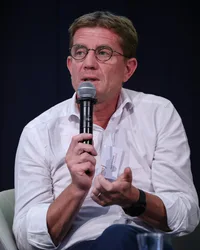

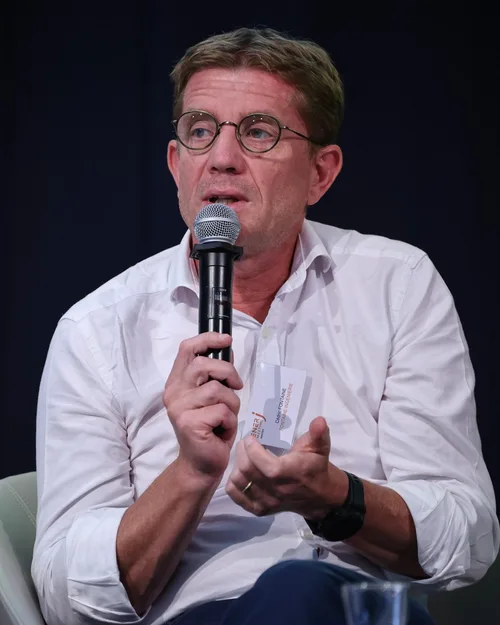
Cédric Fontaine - Speaker on eau
Making you happy when it rains
Rainwater, everyone talks about it. But who really explains it simply?
A pioneer in the valorization of rainwater since 2005, I have worked on hundreds of projects — for individuals, communities, and industries — and have continuously expanded my expertise: parcel water management, greywater recycling, anticipating the challenges related to climate change. Twenty years of fieldwork, concrete solutions, and keen observation of what water does — or no longer does — in our landscapes.
But what sets me apart from other expert voices on the subject is not the depth of my science. It’s the way I convey it. No complex models reserved for insiders and especially, no catastrophic discourse. Instead: a direct pedagogy, accessible to all audiences, that untangles the true from the false, questions preconceived ideas, and — above all — provides concrete action paths that anyone can take ownership of.
My credo: water is a common good, and the more educated we are, the more we can protect it. So I educate, with enthusiasm and without condescension.
Vice-president of the rainwater commission within the ATEP (Actors of Water Treatment at the Parcel Level), I am also one of those who push for change at the professional level — so that rainwater is finally recognized as a resource, and not as waste to be disposed of.
In conferences, I take my audience on a journey between science, common sense, and pragmatism. We leave with clear answers, new reflexes — and a smile. Because a conference on rainwater led by a somewhat chauvinistic Breton named Fontaine can only be a lively, grounded, and memorable moment.
Cédric FONTAINE
Need a speaker on these topics?
Frequently asked questions
Which topics does Cédric Fontaine cover as a speaker?
Cédric Fontaine speaks on the following topics: eau, transition ecologique, changement climatique, developpement durable, environnement, sobriete, urbanisme and secheresse.
How do I book Cédric Fontaine for a conference?
To book Cédric Fontaine, contact the Lespeakers agency. An advisor will call you back to scope the event, dates and format.
How much does a conference with Cédric Fontaine cost?
Cédric Fontaine's fees:
- Conference : 3000 €
Booking is handled through Lespeakers.
Which languages does Cédric Fontaine speak on stage?
Cédric Fontaine speaks as speaker in french.
Where is Cédric Fontaine based?
Here is where Cédric Fontaine is based: Rennes, France.
Where does Cédric Fontaine speak?
Cédric Fontaine's speaking locations: France · Belgique · Suisse.
Which speaking formats does Cédric Fontaine offer?
Cédric Fontaine offers the following formats: Conférence, Séminaire, Convention, Atelier.
Which audience should book Cédric Fontaine?
Elus, Architectes, Managers.
What did Cédric Fontaine do before becoming a speaker?
I always do it: I run Fontaine Ingénierie, the engineering office I created in 2005 in Rennes, specialized in rainwater harvesting, stormwater management at the plot level, and greywater recycling. Audits, sizing, regulatory expertise, training.
The conference came later, almost by accident: by repeatedly explaining the same things in construction meetings and training sessions, I eventually realized that the real gap was not technical. It was educational.
Why book Cédric Fontaine rather than another speaker?
Because the topic of water is saturated with two profiles: scientists, whose discourse is correct but inaccessible, and activists, whose discourse mobilizes but remains little operational. I come from a third place: twenty years in an engineering office, hundreds of real installations, and a pedagogical obsession. I know how to size a tank, and I know how to explain it to an audience that has never heard of a runoff coefficient.
And incidentally, my name is Fontaine and I am Breton — on a subject as serious as water resources, an audience appreciates being allowed to smile.
What is Cédric Fontaine's speaking angle?
Neither catastrophism nor solutionism. Most interventions on water choose one of the two: either we scare people, or we sell a miracle technology. I do the opposite — I first explain the mechanism (the soil, the climate, the water cycle), then I honestly say what works, what doesn't work, and in what context. Including when the answer is 'at your place, it doesn't matter'.
It's less spectacular, but it's what makes an audience leave with decisions rather than guilt.
Why do organizers like working with Cédric Fontaine?
Because I respond quickly, I complete the brief before they ask me again, and I arrive early. Twenty years in a design office teaches one thing: to meet deadlines and written commitments.
Specifically: a framing exchange in advance, materials sent when they need them and not the day before, a presentation that ends at the announced time, and I stay afterwards for questions. I prefer that an organizer calls me back the following year rather than finding me brilliant just once.
Professional career
- 2022Vice Président de la commission eaux pluviales
ATEP (Acteurs du Traitement des Eaux à la Parcelle
- 2018Formateur
FONTAINE INGENIERIE
- 2015Spécialisation en bureau d'étude
FONTAINE INGENIERIE
- 2005Créateur d'entreprise
FONTAINE INGENIERIE
His conferences
Water sobriety in companies: reducing potable water consumption through rainwater and greywater, without stopping production or waiting for the next drought
As long as water costs a few euros per cubic meter, no one pays attention to it. Then comes the prefectural decree of restriction, the water line that doubles in the budget, the industrial site that can no longer be expanded due to lack of resources — and suddenly water becomes a topic for the management committee.
This conference starts from a simple observation: in most companies, a large part of the purchased potable water does not need to be potable. Cleaning, sanitation, irrigation, cooling, non-food processes: these are uses that properly filtered rainwater or recycled greywater can cover very well, and for which the potable water network is a technical luxury.
I outline the method as applied in a design office: mapping actual uses, identifying those that can switch, sizing the available resource on one's own surfaces, and calculating the payback time honestly — including when it is poor. We review what French regulations say about the reuse of unconventional waters, what it has recently authorized, and the health vigilance points that should not be taken lightly.
Without moralizing discourse or magical promises: what is profitable, what is not yet, and what will become so when water is counted. An intervention for executives, CSR managers, industrial management, and technical services, with orders of magnitude, real cases, and decisions to be made.
The city that drinks its rain: managing water at the plot level to cool down, de-seal, and reduce flooding, without digging new networks
For a century, urban planning has had only one reflex in the face of rain: to evacuate it. Quickly, far away, underground. The result is now before us — sealed soils that no longer recharge the aquifers, networks saturated at the first storm, city centers that reach 40 °C in August, and aquifers that continue to be pumped while the water from the roof across the street flows into the stream.
The good news is that the turnaround is already written in regulations and urban planning documents: managing rainwater at the plot level is becoming the rule, evacuation the exception. The question remains what this concretely means when you are a mayor, deputy to urban planning, architect, or project owner — and especially what really works on the ground.
In this conference, I start from the soil, climate, and water cycle to show what is really at stake beneath our developments. Then we review the solutions, without bias: swales, permeable pavements, storage roofs, infiltration, recovery, de-sealing of schoolyards. What each costs, what it brings, in what soil context it is a good idea — and in what context it is a costly mistake.
We conclude with the tricky question: where to start with a municipality's budget, and how to engage the residents. A field intervention, without catastrophism, designed to leave with actionable decisions the very next day.
Understanding rainwater, simply: untangling the truth from the false between drought and flooding, and finally knowing what to do with the rain that falls at your place
At a cocktail party, a stranger approaches me: "You are a rainwater specialist? Perfect — I understand absolutely nothing about it."
He then explains his dismay:
- on Monday, he hears that we are short on water, that we are in a drought. On Tuesday, that we are at risk of flooding.
- One day, he is advised to collect rainwater for his garden. The next day, he is told that it is a bad idea that disrupts the natural water cycle.
Too much contradictory information, too many discourses that all seem relevant — and in the end, total misunderstanding. That evening, a conference was born.
Because rainwater is the topic where everyone has an opinion, where contradictions accumulate, and yet everything can be explained. So we will start from the beginning:
- how the water cycle works
- what climate change is profoundly modifying
- what you can really implement — or not.
Challenged preconceived ideas, accepted paradoxes, concrete answers.
In short, everything you need to know about rainwater, without leaving more lost than when you arrived.
To learn more about the conference: https://youtu.be/-vSKMvkxfms