

A generic talk on stress management rarely leaves a lasting impression: vague advice, familiar anecdotes, and few practical levers for your teams. In contrast, inviting a speaker on stress with real hands-on expertise gives your seminar or corporate conference an immediate and measurable impact. The best speakers know how to decode the mechanisms of workplace stress, but above all, offer solutions tailored to your reality: managing pressure, preventing burnout, or communicating during tense periods.
The difference between two profiles often lies in the ability to make the message resonate with employees who are usually already aware of the issue... but rarely equipped to deal with it. A recognised speaker on stress will create that spark your teams need, whether it’s a board facing major challenges or a team seminar looking for renewed momentum. Here, you can compare seasoned specialists, able to turn a key moment of your event into a true accelerator for change.
Read more Read less
When the pressure rises, so does your audience’s attention
An engaging talk on stress is unlike any other presentation. For your teams, stress isn’t just a concept: it can be felt, recognised, and shared. A speaker on stress who dares to talk about their own moments of tension, failures, or comebacks captures attention where overly polished speeches fall flat. This authenticity is what turns stress into a powerful topic, not just a minor issue discussed over coffee breaks.
At a seminar or convention, seeing a speaker give substance to the invisible opens the door to conversations no one dared to start. A talk on stress that’s rooted in real-life experience resonates differently and leaves a lasting impression on participants.
The subtle signs of stress: when they reveal more about your organisation
It’s often assumed that stress management only concerns exposed managers or high-pressure roles. In reality, every employee, from head office to the field, encounters symptoms that go unnoticed: brief lapses in attention, underlying fatigue, sudden irritability. A speaker on stress knows how to put words to the invisible and highlight, without stigmatising, those subtle signals that undermine collective performance.
Their role? To give every participant the chance to recognise themselves in real situations, where generic messages miss the reality of daily experience. This turns a talk on stress into a large-scale tool for detection and mobilisation.
Moving beyond the ‘good stress’ myth: the real breakthrough in a talk
Who hasn’t heard that a little stress can be beneficial? Yet, this belief often hides situations that worsen without the right support. The strength of a good speaker is to challenge the myth and show that what energises some can hold others back or even cause harm.
During a talk on stress, your teams discover tools to move beyond the classic idea that ‘too much is harmful, but a little is good’. This sparks real discussions about prevention, team cohesion, and the ability to act collectively on the work environment.
The right match, without stress: how Lespeakers makes your choice easier
Finding a specialist speaker on stress who fits your company culture isn’t just about a CV or job title. We select profiles who know how to adapt to your reality: sector, pace, transformation challenges, and your audience’s expectations.
Every talk on stress we offer is tested for real-world impact: speaking honestly, sharing practical tools, and engaging even a sceptical audience. Our mission: to ensure the session is as impactful as it is reassuring, so that stress is no longer a blind spot in your organisation.




Discover our speakers and experts on stress
We help you find the right speaker
Share your needs with us: we'll contact you in under an hour.
After a quick exchange, we'll come back with a tailored selection of speakers.
Confirm your choice and sign off with your selected speaker.
Pierre henri Chuet
•Fighter pilot on Rafale Marine •TV Consultant in Canada • Entrepreneur in the UK •TedX Speaker •Stroke Survivor
- Spoken languages
- French, English
Pierre-Henri helps leaders unlock the full potential of their teams in a stressful work environment, using proven methods from aviation. He has 18 years of civil and military aeronautical experience. A former fighter pilot of the Naval Aviation, he was trained by the U.S. Navy and has developed a unique international experience: A mix of combat, air demonstration aboard the Rafale Marine (200 landings) and partic…

Ben Campagna
Multidisciplinary expert in chronic stress and sustainable performance, Ben Campagna supports leaders and management teams from exhaustion to resilience and alignment.
- Spoken languages
- French, English
Ben Campagna is an international speaker, executive coach, and specialist in human behavior, sustainable performance, and human optimization. With an academic background in psychology and sports sciences, combined with advanced training in behavioral change, neuroscience, emotional intelligence, physiology, and performance coaching, he has spent over 12 years working with executives, management teams, and high-perf…
Julien parfait Gallois
🏆SUCCESS THROUGH SPIRITUALITY 🙏🏼
- Spoken languages
- French, English
My name is Julien Parfait Gallois, I am 25 years old, and I consider myself a free spirit today. I undertake, I create, I share my truths, I travel... I have created a life in which I have completely detached myself from the traditional format in which we are taught to live (commute, work, sleep). After having: - Created an eCommerce business that generated over €350,000 in revenue in a year and a half - Created a…
Conferences

Bertrand Piccard
Explorer, Doctor, and Opinion Leader
- Spoken languages
- French, English
Bertrand Piccard is the founder and visionary behind Solar Impulse, the first fuel-free aircraft with perpetual autonomy. It is in his genes to go beyond preconceived ideas to achieve the impossible. Coming from a legendary lineage of explorers and scientists who have conquered the heights and depths of our planet, he made history by accomplishing two aeronautical firsts: a non-stop round-the-world balloon flight an…
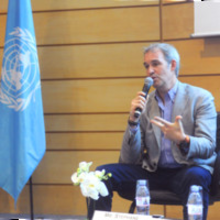
Stéphane Haskell
Author Director named "Goodwill Ambassador" for yoga by UNESCO
- Spoken languages
- French, English
Director, photojournalist, and writer, Stéphane Haskell spent 12 years at the Sipa Press agency before turning to documentary filmmaking. His films shot in all corners of the world are broadcast on French (TF1, France 2, France 5, and LCP) and international channels. Recently, his film, BREATHE: Yoga a Breath of Freedom, aired on Public Sénat and reached over 1 million viewers, winning numerous awards at festivals i…
Frequently asked questions about speakers on stress
What budget should I plan for a speaker on stress?
The budget for a speaker on stress depends on their profile, reputation, and the format you require. For a corporate event, you should generally expect to pay between €2,000 and €6,000, excluding travel expenses. A well-known expert or media personality may charge more. Be sure to specify your expectations from the outset: duration, interaction, and adaptation to your sector. Some speakers also offer complementary workshops or Q&A sessions, which can affect the fee.
How do I choose the right speaker on stress for my team?
The key is to align the style of the speaker on stress with your company culture and your employees’ experiences. A group of managers will appreciate a speaker with hands-on experience and practical solutions, while a remote team will be more receptive to tools for managing mental load at a distance. Always ask for examples of previous talks similar to your context: the relevance of the content makes all the difference.
Can a speaker on stress adapt to a reluctant or sceptical audience?
Yes, but it depends on their ability to quickly build trust. A good speaker on stress often starts with personal anecdotes or familiar situations. They know how to avoid medical jargon and use humour or self-deprecation to break the ice. If your audience has already attended similar training sessions without impact, mention this in advance: some speakers will then adapt their approach to avoid repetition or surprise participants.
What is the ideal length for a talk on stress in a company?
In practice, 45 minutes to 1 hour is the most popular format for a talk on stress in a corporate setting. Beyond that, attention tends to drop, especially if the topic is sensitive or part of daily life. Allow time for discussion at the end: often, the real questions come up after the presentation. For a packed event, a short and impactful format works better than an overly detailed session.
What profiles of speakers on stress are best suited to the HR sector?
For HR, choose a speaker on stress who has already supported organisational change or teams in transition. A speaker with dual experience (for example, in psychology and management) can address both prevention and crisis management. Some profiles from sport or healthcare also bring an operational perspective that resonates with HR professionals dealing with absenteeism or demotivation.
What mistakes should I avoid when choosing a speaker on stress?
The first mistake is choosing a speaker on stress solely based on their CV or reputation. A brilliant talk that’s disconnected from your teams’ reality will have little effect. Another pitfall: neglecting the format and interactivity. A speaker who doesn’t take the time to understand your challenges may deliver a generic presentation with no lasting impact.
What impact can you expect from a talk on stress for an executive committee?
For an executive committee, a speaker on stress can act as a catalyst: they highlight subtle warning signs and open up discussion on topics that are sometimes taboo, such as overload or the difficulty of switching off. The real impact depends on the speaker’s ability to make concrete situations experienced by leaders visible, and to suggest action points tailored to their level of responsibility.
How does Lespeakers select its speakers on stress?
Lespeakers selects its speakers on stress based on their professional experience, ability to share practical tools, and adaptability to different audiences. Each speaker is assessed on the relevance of their examples, the quality of their feedback, and their ability to create genuine interaction, even in tense or sensitive contexts.