

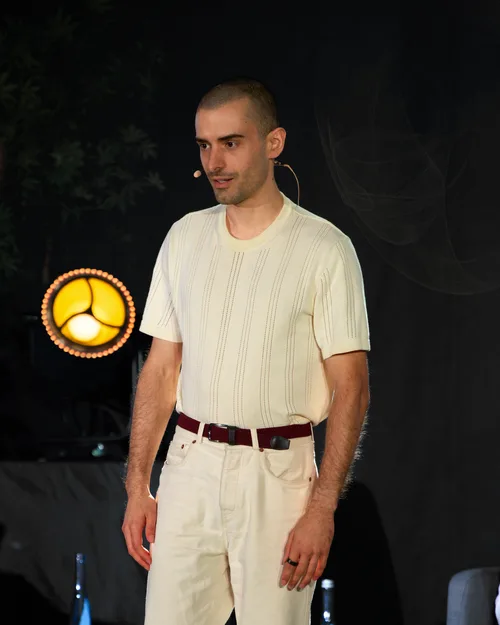
Pierre Gerbaud - Speaker on robustness
International Conference: "From Chaos to Trust", the tools to build your system adapted to chaos.
Pierre has experienced chaos in all its forms:
- Executive producer of short films in extreme conditions
- Founder of startups in turnaround markets (Fluximmo)
- Administrator in organizations on sensitive topics
- Organizer of international cooperation events in India with the Minister of Law of the Government of India.
A mistake recurs in every chaotic environment: trying to impose order.
Chaos is not resolved with order. Order works in a stable and predictable environment.
In a chaotic system, we change our prism, our way of seeing. We change the organization to trust in its ability to be robust.
A chaotic system meets these criteria:
- "Paradigm shifts" are continuous.
- Visibility is reduced to six months.
- It becomes difficult to assess the impact of changes.
The answer to regain the power to act lies in: a strategy, tools, cultural reflexes.
Pierre helps leaders and their teams build an organization that will have the capacity to absorb changes. Even to profit from them.
Pierre energetically presents simple principles, concrete examples. The goal: to leave with a breath of a new kind.
The work is based on mathematical modeling of chaos, systemic approach, and complexity theories. All of this, simply stated.
Notable interventions: Mulliez Family Association, HEC Paris, IVECO, School 42, Indian Ministry of Law and Justice.
Need a speaker on these topics?
Frequently asked questions
Which topics does Pierre Gerbaud cover as a speaker?
Pierre Gerbaud speaks on the following topics: robustesse, resilience, management, transformation, incertitude, complexite, strategie and interculturel.
How do I book Pierre Gerbaud for a conference?
To book Pierre Gerbaud, contact the Lespeakers agency. An advisor will call you back to scope the event, dates and format.
How much does a conference with Pierre Gerbaud cost?
Pierre Gerbaud's fees:
- Conference : 3500 €
Booking is handled through Lespeakers.
Which languages does Pierre Gerbaud speak on stage?
Pierre Gerbaud speaks as speaker in french and english.
Where is Pierre Gerbaud based?
Here is where Pierre Gerbaud is based: Paris, France.
Where does Pierre Gerbaud speak?
Pierre Gerbaud's speaking locations: Dans le monde entier.
Which speaking formats does Pierre Gerbaud offer?
Pierre Gerbaud offers the following formats: Conférence, Atelier, Séminaire.
What did Pierre Gerbaud do before becoming a speaker?
I was an executive producer of short films shot in extreme conditions, then founder of Fluximmo, a startup launched in a turning real estate market.
I also serve as a board member in organizations dealing with sensitive issues.
What is Pierre Gerbaud's speaking angle?
I apply mathematical models of chaos and complexity theories to management, drawing on authors like Ross Ashby, Edgar Morin, or Olivier Hamant. I translate them into simple principles and concrete examples, without jargon.
His conferences
Gaining confidence when it's chaos: how an organization stays on course when plans no longer hold after 6 months
Many executive committees I meet are experiencing the same situation. The pace is increasing as the company changes its model, and the plans established at the beginning of the year no longer hold a few months later. Everyone is doubling their efforts without the results following in the same proportions. The temptation is then to take control back by adding oversight and indicators, as if the uncertainty stemmed from a lack of rigor.
In this conference, I propose to look at the situation differently. I rely on mathematical models of chaos and theories of complexity to show that an organization tips into chaos when the energy entering it exceeds its capacity to absorb it. This tipping does not come from poor management: it often accompanies a company that is growing or transforming.
I then describe the traps into which most leadership teams fall, such as the search for a scapegoat when a problem has multiple causes, or the promise of a return to calm that ultimately erodes the teams' trust. To each of these traps, I oppose a concrete response. Subsidiarity brings decision-making closer to the ground, and emotional safety allows alerts to rise before it's too late.
The conference is aimed at executive committees and managers who are leading a transformation. I delivered it in June 2026 in front of the executive committee of IVECO, at the time when the factory was doubling its production rate while transitioning to electric, and I adapt it each time to the situation of the company that invites me. Participants leave with a shared understanding of what they are going through and some actions to implement as early as the following week.
Making France and India Work Together: Understanding the Differences Between Our Two Cultures to Succeed in Working Together Daily
Acquisitions between French and Indian companies are multiplying, and many stumble over misunderstandings that no one names. A "yes" spoken in a meeting does not hold the same value in Paris as it does in Mumbai. A disagreement expressed frankly to a superior is seen as a lack of respect on one side and as honesty on the other. Each side thinks the other has understood, until the day a goal is not met.
In this conference, I start from what I observed while organizing the Tour de Thar with Devansh Parnami, a cooperation event between France and India initiated by Arjun Ram Meghwal, the Indian Minister of Law and Justice. I do not present a list of stereotypes. Behavior is never solely cultural: it also depends on the history of the acquisition and the constraints of daily life.
I describe the gaps that occur most often, such as the confusion between a goal and a forecast, and I show what brings the two cultures closer, notably a shared relationship to hierarchy and the appreciation of a relationship that is built over time. I then propose simple tools to make explicit what is not, for example distinguishing several levels of commitment when someone says yes, or setting an expiration date for any provisional solution.
The conference is aimed at executives and managers of companies that work with India or have just acquired a company there. Participants leave with a common vocabulary to understand each other more quickly.
Robustness: Drawing Inspiration from Life to Build an Organization that Withstands Shocks Without Sacrificing Performance
Most organizations have been designed for a stable world. They seek maximum efficiency and reduce their margins wherever possible, which works as long as the environment remains predictable. When shocks approach, this optimization becomes a fragility: the slightest disruption disorganizes the whole, and it then takes months to recover.
In this conference, I draw inspiration from living systems, which have combined performance and robustness for millions of years. I particularly rely on the work of biologist Olivier Hamant on the robustness of life, and on that of Nassim Taleb on systems that leverage disorder. Living systems maintain redundancies and a degree of slowness that we tend to eliminate in a company, and it is precisely this that allows them to absorb a shock instead of suffering it.
I then show how to transpose these principles into an organization, particularly where to accept redundancy and how to grant more autonomy to teams close to the ground. I illustrate these principles with situations I have experienced as a producer of short films shot in extreme conditions, and then as the founder of Fluximmo, a startup launched in a turning market.
The conference is aimed at leaders and teams who want to move away from a state of permanent crisis management. Participants leave with a framework to identify, within their own organization, the areas where optimization has made them fragile.
Deciding in Uncertainty in the Age of AI: What Changes for Leaders When Machines Accelerate Everything Without Making the Future More Predictable
Artificial intelligence promises to better predict, and many companies expect it to reduce uncertainty. In reality, it mainly accelerates the pace. Product cycles shorten, new competitors emerge within months, and jobs change while teams are being trained. AI adds energy to organizations that are already struggling to absorb it, and six-year plans no longer last six months.
In this conference, I connect two subjects that I practice daily. The first is the science of chaos and complexity, which explains why a system subjected to too much energy becomes unpredictable. The second is my concrete use of AI: I have several agents working in parallel on my own projects every day, with shared memory and human validation at every important decision. This practice has taught me where the machine really helps in decision-making, and where it only gives the impression of having reduced uncertainty.
I show why finer predictions do not replace an organization's ability to absorb the unexpected. I then propose simple practices to keep human decision-making where it matters, such as maintaining wide margins rather than optimizing every resource, or delegating a decision back to the team that has the richest information.
The conference is aimed at executive committees and managers who are integrating AI into their organization without yet knowing what it will change. Participants leave with benchmarks to distinguish what AI can predict from what will remain uncertain, and to decide nonetheless.