

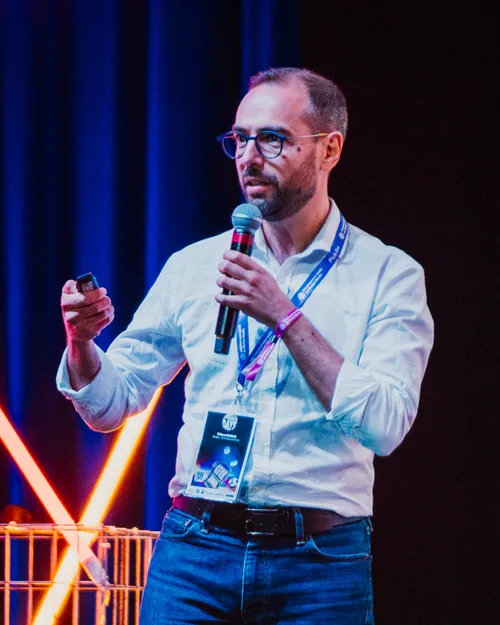
Thibaud Dumas - Speaker on neurosciences
Doctor in neuroscience, Thibaud Dumas brings to life in the room what screens and AI do to our attention, our energy, and our decisions.
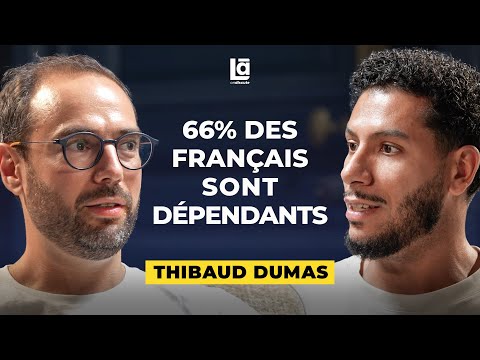
Thibaud Dumas holds a PhD in cognitive neuroscience. He completed his thesis at the Brain Institute at Pitié-Salpêtrière before founding MyBrain Technologies, an award-winning neurotechnology startup at CES. Since 2018, he has dedicated himself to knowledge transfer, with a question that has never left him: what do our digital tools do to our brain, and how can we regain control without giving them up?
He has given over a hundred conferences for Google, AXA, BNP Paribas, Disneyland Paris, Groupama, Engie, or France TV, in front of audiences ranging from a few dozen people to 10,000 employees connected worldwide. He has spoken in front of both executive committees and audiences of doctors, project leaders, or communicators, adapting each presentation to the audience he faces.
His conferences are based on live experiences with the audience. Participants witness for themselves what happens in their minds in a hyperconnected world, and this is often what they remember the longest.
He currently offers three signature conferences. The first, on hyperconnectivity, shows what our screens do to our attention over the course of a workday. The second focuses on AI and the brain, that is, what changes in our way of thinking, learning, and deciding when we delegate some of these tasks to a machine. The third, dedicated to sustainable performance, teaches how to manage mental energy over time, drawing on examples from high-level sports. All can be delivered in 30 minutes or 1 hour, in person or via video, in French, English, or Spanish.
He is the author of five books, including Why Does Our Brain Love Scrolling? (La Martinière, 2026). He chairs the Attention Hyperconnection association, co-founded the media outlet Pouce!, and teaches at universities or higher education schools.
Need a speaker on these topics?
Frequently asked questions
Which topics does Thibaud Dumas cover as a speaker?
Thibaud Dumas speaks on the following topics: neurosciences, cerveau, hyperconnexion, intelligence artificielle, digital, performance, qvt and efficacite.
How do I book Thibaud Dumas for a conference?
To book Thibaud Dumas, contact the Lespeakers agency. An advisor will call you back to scope the event, dates and format.
How much does a conference with Thibaud Dumas cost?
Thibaud Dumas's fees:
- Conference : 5500 €
Booking is handled through Lespeakers.
Which languages does Thibaud Dumas speak on stage?
Thibaud Dumas speaks as speaker in french, english and spanish.
Where is Thibaud Dumas based?
Here is where Thibaud Dumas is based: France.
Where does Thibaud Dumas speak?
Thibaud Dumas's speaking locations: Dans le monde entier.
Which speaking formats does Thibaud Dumas offer?
Thibaud Dumas offers the following formats: Conférence, séminaire, production de vidéo.
Which audience should book Thibaud Dumas?
Managers, dirigeants, comités de direction, collaborateurs, entrepreneurs.
Professional career
- 2026Cofondateur
Pouce! Média
- 2020Cofondateur et Président
Association Attention Hyperconnexion
- 2014Cofondateur et Directeur Général
myBrain Technologies
- 2013Doctorat en neurosciences cognitives
Sorbonne Université / Institut du Cerveau
His conferences
Hyperconnection: What Our Screens Do to Our Brain, and How to Take Control Without Giving Up Digital
Notifications, messaging, video meetings, news feeds: throughout a workday, our attention is solicited hundreds of times, and we are rarely aware of what this costs our brain. This conference starts from this daily reality to understand what really happens when we switch from one screen to another, and why we find it so hard to disconnect.
Thibaud Dumas, a doctor in cognitive neuroscience, relies on the latest research to explain how attention works, why multitasking is an illusion that exhausts us, and the mechanisms by which applications capture our time, from the reward circuit to the interruptions that fragment our concentration. He also addresses the issue of screen addiction, distinguishing between what science establishes and what belongs to fantasy.
The conference is based on live experiments with the audience. Participants witness for themselves the limits of their attention, making the discussion very concrete and giving everyone the desire to change a few habits.
The goal is not to demonize digital technology, but to provide simple and immediately applicable keys: organizing one’s days to preserve concentration times, reducing unnecessary solicitations, recovering better, and collectively establishing healthier usage rules.
Format: 30 minutes or 1 hour, in person or via video, in French, English, or Spanish.
AI and the brain: what artificial intelligence changes in our way of thinking, learning, and deciding, and how to keep it at our service
In just a few months, generative AI assistants have become part of the daily lives of millions of employees: they are entrusted with writing an email, summarizing a report, preparing a meeting, and sometimes even making a decision. These tools save precious time, but one question remains largely absent from AI training: what happens to our brain when it delegates part of its work to a machine?
Thibaud Dumas, a doctor in cognitive neuroscience, relies on the first studies dedicated to the subject to show what is at stake in our memory, attention, and critical thinking when we use AI in our daily lives. He explains why an effort that we no longer make is a skill that we maintain less, why we tend to trust a fluid and well-formulated answer, and how AI can, on the contrary, become a wonderful learning tool when we use it to think rather than in its place.
The conference also addresses the relational dimension of these tools, increasingly designed to converse with us as a colleague or even a friend would, and what this changes in our relationship to work and to others.
Far from enthusiastic speeches or catastrophic scenarios, the goal is to provide teams with concrete benchmarks to integrate AI into their work while retaining control over what makes their value: judgment, creativity, and the ability to learn.
Sustainable performance: what neuroscience teaches us about managing our mental energy and enduring over time
There is much talk about performance at work, much less about what it costs our brain. Back-to-back meetings, constant demands, decisions made in haste, too short nights: our mental energy is depleted by a multitude of small leaks of which we are rarely aware, until the moment when the quality of our work, our decisions, and our health suffer.
Thibaud Dumas, a doctor in cognitive neuroscience, proposes to look at performance differently, as a resource to manage rather than an effort to maximize. He explains how the brain processes information, why it gets tired, and what happens when we ask it to manage everything at once for too long. He connects this knowledge with the example of high-level athletes, who have long known that recovery, sleep, and managing peak times are just as much a part of performance as training itself.
The conference relies on live experiments with the audience that show in seconds how a simple distraction slows down and degrades our information processing. Participants leave having personally felt the cost of an interruption.
The goal is to provide everyone, and teams, with concrete benchmarks to identify their own energy leaks, organize their days around real times of concentration and recovery, and establish a work rhythm that allows for performance without exhaustion.
Format: 30 minutes or 1 hour, in person or via video, in French, English, or Spanish.