
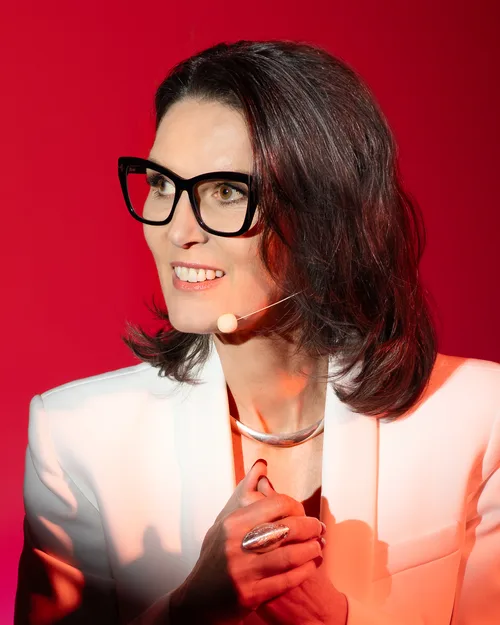
Cécile Bastien Remy

Performance through Resilience — How Leaders Advance Despite Pressure

Cécile Bastien Remy, conférencier

The Speaker Behind the Talk At 21, Cécile survived a car accident that left her 45% disabled. She didn’t just ‘bounce back’; she learned to perform under pressure. This experience became the foundation of a career built on a conviction: resilience is not about survival. It’s about performance. TEDx Speaker | Best Speaker in Switzerland 2015 & 2018 | Bilingual EN/FR 🎬 Presentation Video: https://youtu.be/hG0oCs2FpXw Why This Talk, Why Now 82% of employees are at risk of burnout. Leaders must decide faster, communicate clearly, and continuously adapt in conditions that would exhaust anyone. The question is not whether your leaders face pressure. It’s whether they are equipped to perform despite it. What the Audience Takes Away Through the framework of Performance through Resilience, leaders learn to: - Transform setbacks into sources of strength and strategic clarity - Develop mental toughness that withstands sustained pressure - Communicate with authority in high-stakes situations - Guide their teams through uncertainty without losing engagement or trust This is not inspiration. It’s a toolbox. What Clients Say “An exceptional speaker. Cécile electrified the room. Our audience left inspired and full of energy.” — CEO, Risk!n Conference, Zurich “Cécile captivates, blending research and practice, and managers leave ready to act.” — Chief of Staff, Credit Suisse Format 45 to 90 minutes | Executive Committees, Leadership Teams, Corporate Events Available in English or French Optional: follow-up workshop, coaching program, or 6-month cohort

Prices

  • Conference : 7500 €

Localization

Zurich, Switzerland

Languages

English, French

My conferences

Conference #1

How Senior Leaders Build Resilience Under Pressure and Deliver Sustainable Performance in Uncertain Times

THE SPEAKER BEHIND THE TALK At 21, Cécile survived a car crash that left her 45% disabled. She didn't bounce back, she learned to perform under pressure. That experience became the foundation of a career built on one conviction: resilience isn't about survival. It's about performance. TEDx Speaker | Best Speaker Switzerland 2015 & 2018 | Bilingual EN/FR 🎬 Speaker reel: https://youtu.be/hG0oCs2FpXw WHY THIS KEYNOTE, WHY NOW 82% of the workforce is at risk of burnout. Leaders are expected to decide faster, communicate clearer, and adapt continuously; in conditions that would exhaust anyone. The question isn't whether your leaders face pressure. It's whether they're equipped to perform through it. WHAT THE AUDIENCE WALK AWAY WITH Using the Bounce Forward framework, leaders learn to: - Turn setbacks into a source of strength and strategic clarity - Build mental fitness that holds under sustained pressure - Communicate with authority in high-stakes situations - Lead teams through uncertainty without losing engagement or trust This is not inspiration. This is a toolkit. WHAT CLIENTS SAY "An exceptional speaker. Cécile electrified the room. Our audience left inspired and fully energized." — CEO, Risk!n Conference, Zurich "Cécile captivates, blending research and practice, and leaves managers ready to act." — Chief of Staff, Credit Suisse FORMAT 45 to 90 minutes | Executive Committees, senior leadership teams, company-wide events Delivered in English or French Optional: follow-up workshop, coaching program, or 6-month cohort

Learn more

Who am I?

What I did before becoming a speaker

Before becoming a speaker, I spent about fifteen years in high-end B2B sales: Sales Executive in financial databases, between London, New York, and Paris. An ultra-competitive world where resilience is not a concept, it's a condition for survival.

Later, once settled in Switzerland, I co-founded Gruezi Newcomer, a publishing house dedicated to expatriates and newcomers, because the question of "how to rebuild oneself elsewhere" has always been a part of me, both professionally and personally.

It is this dual background, international commercial experience + entrepreneurial adventure, that today nourishes each of my interventions.

What made me become a speaker

Honestly? It was my clients who pushed me there. In training and coaching, I kept hearing the same thing: "What you say should be heard by many more people." My surroundings also encouraged me to take the leap and get on stage.

And then I realized it was obvious: the conference is the perfect format to convey the message that is closest to my heart. Life's blows are normal. And to overcome them, resilience can be learned. It is not innate, it is not reserved for warriors. It is a skill. Concrete. Accessible. And I am here to prove it.

A failure or turning point that shaped me

When people talk to me about failure or turning points, I talk about trauma. In June 1993, I had an accident that left me 45% disabled, with an invisible disability, and disfigured (and quite well reconstructed!). It was not a professional setback. It was a before and after.

That's where it all began. Not the choice to "bounce back", but the choice to survive, then to live, then to build. It is from this accident that my deep passion for resilience was born. Not in books, not in a training room, but in my flesh. Today, I get on stage to say one simple and powerful thing: what I went through, I transformed into strength. And this strength is transferable.

What excites me about working as a speaker

What excites me? The investigation before the stage. Approaching my audience before getting on stage, exploring their fears, understanding the circumstances that block them, searching for the keys, the anchor points, the perspectives that will resonate for them.

When someone offers me their attention, it is precious. So I don't show up with a pre-fabricated speech. I build a tailor-made experience to inspire, equip, and transform.

That's what makes me vibrate: the moment I feel that a word, an image, an angle has clicked in the room. That someone leaves with something they didn't have when they arrived.

The mission I'm carrying today

My mission is simple and urgent: to reduce the human and economic cost of distress by making resilience a pillar of performance.

Because resilience is not about resisting. Resisting makes you crack. It’s about being agile, recovering after a trial, putting words to what existed in the unconscious state. It’s a high-performance skill.

Companies that understand this, those that build a true culture of resilience, will be the most successful tomorrow. It’s no coincidence that I’ve had the opportunity to train coaches of F1 drivers. In elite environments, resilience is not a "nice to have". It’s the engine.

My job: to bring this culture into organizations, so that every employee, every team, every leader knows how to bounce back. Not just survive. Bounce back.

The belief or message I want to leave for the long term

The message I want people to take away and keep long after the conference is this:

Resilience and performance can be learned, applied, and it’s a conscious choice.

That moment when someone in the audience realizes they have much more power than they believed, that’s my victory. Not the applause. That click. We are not doomed to endure. We can decide. We can equip ourselves. We can choose to bounce back.

This is not positive thinking; it’s a life strategy. And this awareness, once it’s there, doesn’t disappear.

A personal story I often tell

Athens, 2018. European eloquence competition. 350 people in the room. And I fail. Completely.

Why? My ego, my lack of discipline, not enough support around me. The perfect cocktail for failure. And believe me, failing in front of 350 people hurts.

But it’s this misadventure that taught me what no book could have taught me: you don’t become a champion by chance. You become one by choice, by rigor, by humility.

Since that day, I apply these lessons to every preparation, every intervention. Ego in the locker room. Discipline at the center. And the right support by my side.

Beautiful irony: it’s my greatest failure that made me a better speaker.

Where I'm from and what shaped my childhood

I come from France, but from nowhere fixed. My father worked for a state-owned company, and each promotion meant a new city. By the age of 12, I had already had 6 addresses. Six times starting over. New friends, new school, new home.

This constant lack of certainty? It shaped me. It taught me agility, and above all, the ability to connect quickly with others, because when you change worlds every two years, you learn quickly to create bonds or you remain alone.

And then there’s classical dance, and weekends in the mountains with family. Being the youngest, there was no question of lagging behind; I had to physically push myself to follow routes designed for adults. No one slowed down for me.

That’s where my taste for effort, discipline, and self-transcendence was born.

Ultimately, my life as a traveling speaker who reaches out to others, adapts to each audience, and prepares rigorously began long before 1993. It started in my childhood.

The childhood dream that still follows me

At 6 years old, I opened the end-of-year gala at the Casino de Pau. Pointe shoes, tutu, and wide-open eyes.

I still remember everything: the smell of the velvet curtain, the stage floor under my feet, the excitement backstage, the parents in the audience. And that immense joy of sharing something prepared, rehearsed, and polished, with an audience that offers you its attention.

That thrill has never left me.

Today, I still step on stage (with less velvet and tutu, I promise) with exactly the same feeling. The same excitement backstage. The same desire to give the best of what has been prepared.

The little girl of 6 hasn't changed her profession. She has just changed her message.

My memory of speaking in public for the first time

Paris. The Wine Museum. All the crème de la crème of finance is there. I organized the perfect event for the clients and partners of the American company for which I was opening the office. Proud of myself.

Two hours before, my boss: "Is your speech ready?" What speech?

Zero preparation. Zero speaking skills. Panic attack, blackout on stage, polite applause... the kind of applause that hurts even more than silence.

Fortunately, the wines served that evening were excellent. The clients forgot. I never did.

It’s this painful memory that convinced me of one thing: public speaking cannot be improvised. It must be prepared, learned, and practiced. Just like resilience.

The people who most shaped who I am

Two women, two role models, two life lessons.

My mother, first. An absolute example of what it means to live without compromising on one's deep values. Setting clear boundaries to be respected. Talking about everything, nothing is taboo. She taught me that integrity is not a posture, it’s a backbone.

And then Carla Harris. An outstanding speaker, one of the first women I saw on stage who struck me as an obvious choice. I remember exactly what I felt: "When I grow up, that’s what I want to do."

A mother who showed me how to stand tall. A woman on stage who showed me where to go.

I owe them a lot of who I am today.

The choice that most changed my trajectory

Twenty years ago, I arrived in German-speaking Switzerland. Pregnant. A 15-month-old little girl. And not a word of German. Impossible to find work. So rather than endure, I create. With a friend, we opened Gruezi Newcomer, our publishing house. We published two books. And then, I was asked to come and talk about it on stage.

Boom.

I discovered the passion for writing speeches. Then the first client in coaching. The first corporate training. The TEDx. And it continues.

This choice, not to wait for life to adapt to me, but to adapt and create. It’s what triggered everything. It’s the most resilient choice I’ve ever made. Without knowing it, I was already embodying my message.

The speaker on resilience was born from an impossible move.

The values that guide my life off stage

Four values, and one non-negotiable rule.

Resilience, obviously. It’s not just my message, it’s my way of life. Creativity, because the most powerful solutions rarely come from well-trodden paths. Justice and fairness because I deeply believe that everyone deserves a real chance, not just a theoretical one.

And then there’s my non-negotiable golden rule, the one my mother approves of: "don't be an asshole". Treating people with respect, without misplaced ego, without petty power games. On stage as in life.

These are the values that guide my choices, my collaborations, and the way I present myself to the world, with or without a microphone.

The passions and interests that are part of my life

Cold water swimming. Twice a week, I dive into Lake Zurich, in all weather, in all seasons.

It’s not masochism. It’s my most concrete practice of resilience: the cold doesn’t lie. You have to decide, commit, and push through discomfort. And on the other side, mental clarity, energy, and that unique bond with friends who share the same madness.

Nature, body, mind, human connections, it’s all there in that moment.

These daily disciplines and routines allow me to maintain a very active lifestyle and embody what I preach on stage. I don’t talk about resilience from a comfortable chair. I live it, I practice it, I test it in a 5-degree lake if necessary.

What surprises people who only know me on stage

One expects someone intense, serious: resilience, trauma, performance.

And then you meet me and discover someone who laughs easily, who doesn’t take themselves too seriously, and who can talk about their 6-year-old tutu or their polite applause at the Wine Museum without any embarrassment.

What I'm reading, watching, or learning right now

Right now? I’m training in building AI agents because understanding the tools of tomorrow is staying agile today. And in parallel, I’m reading "The Psychology of Money" by Morgan Housel.

Two readings on the same subject ultimately: the relationship between humans and performance. AI forces us to rethink our added value. Housel reminds us that our decisions are rarely rational; they are emotional, rooted in our past experiences.

Resilience, again and always, from different angles.

The advice that most impacted my life

"Stop waiting for perfect conditions."

That's what made me open Gruezi Newcomer pregnant, without speaking German, in Switzerland. The conditions were not perfect. They never would have been.

What I'd tell myself ten years ago

"Life is like a rose: it smells good, it's beautiful, but there will always be thorns. One does not go without the other."

I wish I had told myself that earlier. Stop exhausting yourself wanting a life without thorns. They are part of the bouquet. They are what give relief, depth, and ultimately, meaning.

Resilience is not hoping for a garden without brambles. It is learning to hold the stem without getting hurt.

What I'm most proud of, beyond my résumé

What am I most proud of? It's not on any CV.

It's my ability to bounce back again and again, no matter what life throws at me. It's my energy, that flame that never goes out. And it's that precious thing I've learned over the years: never take life too seriously.

Because deep down, a person who talks about resilience and cannot laugh at themselves is suspicious!

The next chapter that intrigues me

No intrigue, a mission in progress.

I am finishing the first version of my book on resilience: three pillars, three realities: traumas, life's trials, and the daily discipline to be resilient, always and again.

It's not easy to write. Naturally, you can't summarize an entire life of conviction in a few chapters. But it's precisely because it's difficult that it's interesting.

Resilience, even in writing about resilience. Consistent, right?

Positioning & expertise

What concrete problem I can help your audience solve

Discomfort is costly. In human energy, in performance, in euros. Burnout, lack of agility in the face of change, teams that resist instead of bouncing back, these are concrete, measurable problems that hinder organizations.

What I solve: transforming fragility into agility. Teaching individuals and teams not to endure hardships but to navigate them with concrete tools, a different posture, and the conviction that resilience is a choice accessible to all.

No abstract theory. Keys that apply the next morning.

Why book me rather than another speaker?

Because I don't just come to inspire; anyone can inspire for 45 minutes. I come to transform.

An energy that takes the room from the very first second. A "no bullshit" approach, no empty grand speeches, no sugary positive thinking.

Concrete, tools, things applicable the next morning at the office.

Corporate audiences have been fed motivational speeches that evaporate in the parking lot. They want something else. They want to leave with something in their hands.

That's exactly what I provide. Inspiration, yes, but inspiration that is equipped, that is anchored, that lasts.

My specialty in one sentence

Transforming resilience into a performance tool, so that individuals and teams bounce back faster, stronger, today and tomorrow.

Topics I don't cover

Honestly, I have never had to refuse a topic. But my rule is simple: I only take the stage on what I know from the inside.

Not out of fear. Out of respect for the audience that trusts me, and for the subject itself. Credibility cannot be improvised. And nonsense is palpable.

My unique angle

My unique angle? Experience, reflection, and science, all combined.

I don't talk about resilience from a manual. Life has hit me hard, I've managed, I've reflected, I've gone into deep introspection. And I've combined this raw experience with reading, research, and the science of human behavior.

This blend: a real life + a mind that analyzes + evidence that anchors, is what makes my approach unique. Not just moving. Credible.

The field experience behind my message

Everything I say on stage, I have lived, tested, or applied.

An accident with a 45% disability to overcome. An expatriation in an unknown land, pregnant, without language or network. A company created from scratch in adversity. Fifteen years as a Sales Executive in financial databases in London, New York, and Paris where resilience is a daily survival condition. Hundreds of hours of coaching and corporate training. Coaches of F1 drivers coached. A TEDx. And a lake at 5 degrees twice a week.

I don't cite studies. I tell what I've gone through, and what I've seen transform people.

My speaking style in one or two sentences

Direct, embodied, and grounded in reality. Emotion that opens, science that legitimizes, tools that remain. All delivered with an energy that takes the room and doesn't let go.

Which audiences get the most from my sessions

Good question and my answer is another question: who in your company does not need resilience?

New talents, in doubt and in search of meaning. Managers caught between their old operational role and the fear of delegating. Management facing market pressures and the uncertainty of tomorrow. Women who give selflessly and forget to protect themselves. Sales teams who take rejections and must bounce back the next day.

Everyone. Resilience speaks to everyone because everyone goes through tough times, doubts, transitions.

The real question is: who in your organization will go through them with tools, and who will just endure?

Which types of organizations I'm the best fit for

Companies that have understood that human performance is their true competitive advantage.

I regularly intervene in pressured and transforming sectors: Finance, Luxury, Industry, Tech, Consulting, Pharma, and the academic world as well.

Demanding environments where uncertainty is the daily routine, where teams must perform despite everything, and where resilience is not a luxury but a necessity.

Organizations in periods of change: mergers, restructuring, rapid growth, or those facing challenges in talent retention, engagement, and leadership find particular value in my interventions.

Any organization that has understood that a resilient team is a performing team and wants to turn words into actions.

Concrete outcomes your audience can expect after I speak

After my intervention, the audience leaves with three concrete things:

1) Awareness. They realize that they have much more power over their resilience than they believed. It is not innate, it is not reserved for a select few. It is a skill. Accessible. Now.

2) Tools. Not abstract concepts. Practical keys for the next morning: how to get through a trial, how to recover after a setback, how to anchor resilience habits in daily life.

3) A change in posture. They no longer view difficulties in the same way. The obstacle is no longer a threat. It becomes information, an opportunity to adapt and grow.

The true marker of success for me? It is not the applause at the end. It is the message received three weeks later: "I used what you told us and it worked."
The method, framework, or philosophy I stand for

My method is called Bounce Forward and it consists of three steps.

1. Accept. Welcome your emotions and reality without denial. Take an honest inventory of what you have, what you have lost, what remains. No escape, no mask, just the truth as a starting point.

2. Move forward. Give yourself a vision, a goal. And above all, ask for help and accept it. Because resilience is not a solitary sport.

3. Celebrate and narrate. Give meaning to the past trial. Move from being an actor to being the author of your experiences because the way we tell our story determines how we live it.

I developed this framework from my experiences, from science, and from hundreds of hours in the field. It is at the heart of my TEDx Bounce Forward and everything I bring to the stage.

Results & credibility

Career highlights I want to emphasize

A few facts that speak for themselves:

A TEDx, the Bounce Forward method presented to an international audience. Fifteen years of field experience as a Sales Executive in financial databases between London, New York, and Paris. The creation of Gruezi Newcomer, a publishing house, with two published books. Coaching F1 driver coaches. Interventions in the Finance, Luxury, Tech, Consulting, Pharma, and Academia sectors.

Hundreds of hours of coaching and training in companies. And a book in progress on the three pillars of resilience.

But the most striking fact remains personal: 45% disability at 21, an accident that could have stopped everything and that triggered everything.

Clients and sectors that have trusted me

Among the organizations that have already trusted me: Deloitte, Credit Suisse, Holcim, GSK, the University of Zurich, and ETH, to name just a few.

These names say it all: consulting, finance, industry, pharma, academic world.

Demanding environments, sharp audiences, high expectations. And every time, the same feedback: resilience speaks to everyone, regardless of the sector.

What organizers and audiences tell me most often

Three pieces of feedback consistently come back.

"You put words to what we were experiencing without knowing it." This is the most frequent and the most valuable. I become a mirror of their past and present experiences. Something settles, is named, is released.

Inspiration, but not the kind that evaporates. The kind that makes you want to act the very next day.

And finally, the tools. Concrete, applicable, adaptable. To the point that many organizations combine the conference with a workshop to anchor the Bounce Forward method directly into their teams' challenges.

This triptych: mirror, inspiration, tools; is exactly what I aim for in every intervention.

Where I shine most — and when I point you to another option

I excel in corporate events: leadership seminars, team conventions, cohesion days, annual kick-offs.

Audiences ranging from 50 to 10,000 people (hybrid formats). Profiles that have something at stake: managers, talents, leaders, sales teams. People who come looking for meaning as much as for tools.

I perform particularly well when the organizer wants more than a speech, a real experience, with a workshop to anchor the message in concrete.

On the other hand, I would recommend a different format if the goal is purely technical or sectoral. A sharp expertise in quantitative finance or pharmaceutical regulation is not my field.

And if the audience is looking for pure entertainment without transformation, there are excellent comedians for that.

My added value is where humanity and performance intersect. That’s where I am unbeatable.

What I spotlight beyond my profile (book, certifications, proof, etc.)

Beyond the stage, a few elements that anchor credibility:

1) Accreditations & training: Accredited Positive Intelligence Coach, accredited Insights Discovery, trained in Behavioral Panel (behavioral science), validated on Ken Blanchard leadership modules and the Thomas-Kilmann Conflict Instrument. Serious tools, serving interventions that hold up.

2) The academic: Professor in the Faculty of Applied Sciences in communication. Because teaching is also a skill.

3) Writing: Author and editor at Gruezi Newcomer, a cultural assimilation guide in German-speaking Switzerland for expatriates. Two published books, a third in progress.

4) Recognition: Best Speaker Toastmasters Switzerland 2025 and 2026, in French and English. TEDx. And a track record of 100% success in preparing Executive Director promotion interviews in Finance.

Three modes of intervention: conference, corporate training, coaching.

Three ways to anchor the same conviction: resilience can be learned, applied, and transforms.

Speaking style

My energy on stage

Intense and accessible at the same time.

An energy that takes the room from the very first second but never disconnected from reality. True emotion, not a show. Inspiration rooted in experience, not in formulas.

Down to earth. Maybe that's the right word. I don't skim over, I enter the room, I enter the people. What I say, I have lived. And you can feel it.

How audiences experience my sessions (participation, humor, pace)

They sometimes arrive wondering what they are doing there. They leave wondering why no one had told them this before.

First, there is a recognition: "she speaks about me." This feeling of being seen, understood, without judgment. Then something settles. Words on pains they carried without naming them.

Then comes the energy. Not the artificial excitement that fades in the parking lot, a quiet conviction: "I can do something with this."

And they leave with tools in their hands. Concrete. Applicable. Their own.

Visuals and personal stories: what to expect from me

The least amount of PowerPoint possible. The stage, the room, the words, and human contact. No slides to hide behind, no bullet points to fill space. Just a presence.

On the other hand, stories... yes, absolutely. Sometimes mine. Always those of the audience. Because resilience does not live in theories, it lives in the experiences of the people in front of me.

It is their story that I highlight. Mine is just the entry point.

Inspirational keynote vs hands-on workshop; improvisation vs tight structure — how I work

Both, my captain. Keynote and Workshop, it will depend on the audience's availability and the goal to be achieved.

Everything is meticulously prepared: the topic, the angle, the structure, the rhythm. Because relevance cannot be improvised. But this rigorous preparation has another virtue: it frees me. It gives me the security to let go of the script when the room demands it.

...Because nothing ever happens exactly as planned and that's just fine.

Preparation is what allows me to improvise without losing myself. Resilience, even on stage.

How I customize content and how much I tailor to you

An unsuitable keynote is not a keynote; it's a recitation. And recitation is not my style.

Everything starts with the audience: their challenges, their environment, their current fears. The beginning grabs attention because they immediately recognize themselves. The ending resonates because it speaks directly to their reality. And in between, the Bounce Forward method illustrated with their examples, their world, their daily lives.

I do not impose a speech on an audience. I build an experience for them.

What makes my sessions memorable

Three things make it hard to forget me.

1) Simplicity: clear ideas, accessible tools. Nothing I say requires a doctorate to be understood or applied.

2) Immediate action: the next morning, they know what to do. Not in six months, not "when the context is better." Now.

3) And connection: that moment in the room when someone thinks, "she's talking about me." That bond, once created, remains.

We forget the slides. We do not forget what we felt.

The strongest moments and insights I create for audiences

There are three moments that consistently come back.

The moment they realize that life's blows are normal and that it's not an admission of weakness; it's a universal human reality. The room breathes differently at that moment.

The moment they understand that resilience is a conscious choice, not a gift, not a matter of character. A skill. That they can choose to acquire. There, I see the faces change.

And the moment they go from being an actor to being the author of their story. When they realize they have the power to rewrite the meaning of what they've gone through—not the facts, but the meaning. That's often where it touches the deepest.

The emotion or mindset I want people to leave with

Honestly? It's not up to me to decide; it's one of the first questions I ask the organizer during the briefing. Because the target emotion is built together, depending on where the teams are.

What I do know, however, is what I want to have provoked: a transformation. Not just a good moment. Not just emotion that evaporates. A before and an after, however discreet it may be.

That privileged moment that the audience offers me, their attention, their presence, their trust, I take it seriously.

And I want them to leave with something they didn't have when they entered.

Concrete content

The main takeaways participants leave with

Three convictions that are unforgettable: Life's blows are normal. Not a sign of weakness. Not an exception. A universal human reality, and knowing this changes everything. Resilience is learned, applied, and it is a conscious choice. They have much more power than they believed. Once this switch is turned on, it never turns off. One can move from being an actor to being the author of their own story. Rewrite not the facts, but the meaning we give them. And it is this meaning that determines everything.

What your audience can apply the very next day

Three concrete things, starting the next morning:

Name it. Put words to what they are going through, an emotion, a fear, a loss. Not to drown in it. To make it the conscious starting point of a decision.

Choose. Identify one thing, just one, that they have power over in their situation. And decide to act on it.

Ask for help. And accept it. Because resilience is not a solitary sport, and reaching out is an act of courage, not weakness.

Tools, methods, and exercises I provide

Everything will depend on the objective of the Keynote.

The Bounce Forward method in three steps (accept, move forward, celebrate, and tell) is the common thread of all my interventions. But beyond the framework, I provide concrete tools from several disciplines: - Positive Intelligence to identify and disarm the mental saboteurs that hold us back. - Insights Discovery to better know oneself and understand others. - Thomas-Kilmann conflict management tools to navigate tensions without being overwhelmed by them. - And the fundamentals of situational leadership by Ken Blanchard for managers in transition.

All of this is grounded in behavioral science because every tool I offer has a solid foundation behind it.

And for those who want to go further, a workshop to anchor all of this in the concrete challenges of their teams.

Myths and common mistakes I debunk

Some common misconceptions that I systematically debunk:

"Resilience is innate." No. It is a skill. It can be learned, practiced, and developed. Everyone can access it.

"Being resilient means not suffering." False. It is about going through suffering without letting it define you. Pain is part of the journey; denial is not.

"Resisting is being strong." It's actually the opposite. Resistance cracks. Resilience bounces back. They are not synonyms; they are opposites.

"Asking for help is a weakness." This is probably the most costly myth in business. And the most false.

"A good motivational talk is enough." No, inspiration without tools evaporates in the parking lot. What transforms is what can be applied the next morning.

Real-world examples that best illustrate my message

Some true stories that speak better than any theory: - My accident in 1993. 45% disability, disfigured, invisible disability. The before and after. The choice to transform trauma into strength — and into a life mission.

- Athens, 2018. Freezing in front of 350 people at the European eloquence competition. Ego, lack of discipline, lack of support. The most painful — and the most useful — lesson.

- German-speaking Switzerland. Arriving pregnant, with a 15-month-old girl, without a word of German, without a job. Creating Gruezi Newcomer instead of suffering. Bouncing forward.

- The rejected keynote. A client who wanted a speech on employee engagement, six months before a massive layoff plan. I said no. And proposed better. Because resilience starts with telling the truth.

- F1 driver coaches. Because when elite athletes need coaching in resilience, it says everything about the universality of the subject.

Sensitive topics I address frankly, if any

Mental fitness, straightforward. In a corporate world that still confuses performance with invulnerability, naming burnout, anxiety, professional grief is often the first act of resilience.

Invisible disability, mine, and that of all those who "look fine" but carry something heavy in silence.

Failure, the real one, not the watered-down LinkedIn version. The one that hurts, the one we are not proud of, the one that truly teaches.

And grief in all its forms: loss of a job, of a professional identity, of certainty. These griefs exist in companies and we hardly ever talk about them.

My rule: I only address a sensitive topic if I am credible on it. Not to shock but to liberate.

Beliefs or ideas in the audience I aim to shift

Just one but it changes everything: "I am not resilient enough."

This is the most widespread and false belief I encounter. People come in thinking that resilience is a quality that others have and they do not. That they are too fragile, too sensitive, too overwhelmed.

I want them to leave with the opposite certainty: they have already gone through difficult things. They are already resilient, they just don't know it yet.

My job is to show them what they are already doing, to name it, to structure it, and to amplify it.

Resilience is not a gift reserved for warriors. It is a decision. And that decision belongs to them.

The “aha moment” I aim for your audience

The exact moment when they realize that resilience is not a reaction to hard knocks, it is a daily practice.

Not something we activate in an emergency when everything collapses. Something we build every day through our habits, choices, routines. Like a muscle.

That aha moment changes everything. Because it transforms resilience from an abstract concept into something they can decide to cultivate starting tonight when they get home.

Resilience does not start after the trial. It starts now.

Format

On-site, remote, or hybrid: what I accept and prefer

I have practiced all three formats, I accept them all and prefer in-person.

Limits & transparency

How I handle a difficult or low-energy audience

First rule: do not panic. A silent audience is not necessarily a hostile audience; attention is expressed differently across cultures. What seems like coldness in German-speaking Switzerland would be overflowing enthusiasm elsewhere. I read the room, I do not judge it. Then, say out loud what they think quietly. Name the elephant in the room. It breaks the ice better than any team-building exercise. And if it's after lunch and eyelids are getting heavy? We move. Literally. Because bodies awaken minds.

That said, my best weapon against a difficult audience is preparation. Knowing the audience, anticipating resistance, adapting the format before entering the room. A well-prepared pitfall is a pitfall avoided.

And sometimes, accepting that there is no perfect solution. That too is resilience.

If tech fails: how I respond

Systematic checks in advance, prepared backup plan, flipchart as a backup. I do not let technology decide the quality of my intervention.

And if everything fails anyway? I manage without it. Because my format, few slides, a lot of presence, gives me real freedom. Technology for me is a support, not a pillar.

Well, without a microphone in a room of 500 people, it's still more complicated.

What can derail a session, in my view — and how I prevent it

What causes a conference to fail? Poorly targeted preparation. A brilliant speech delivered to the wrong audience, at the wrong time, for the wrong objective.

My solution: a 14-question questionnaire sent even before the first brief. To conduct a real needs analysis, not a surface analysis.

And when the client has an unrealistic wish, I say so. One day, I was asked for a keynote on employee engagement in a company that was going to lay off half of its workforce six months later. I said no. And proposed something more appropriate to the reality of the moment. It worked. Because the right message at the right time is the true respect for the audience.

My job is not to say yes. My job is to deliver what truly transforms.

Logistics & organization

What technical setup I need on site

Microphones according to the size of the audience and connection to a screen if the slides add real value.

My tech rider or logistics document

No

How early I usually arrive before the event

24 hours before (international travel), otherwise at least 2 hours before

Whether I travel internationally and if I need an interpreter

Absolutely, I am bilingual French - English

My slides, filming, and reusing recordings

Absolutely possible, and according to the terms of the contract and after my validation. We discuss it in advance, with no surprises for anyone.

My availability before/after, networking, meet & greet

Absolutely, it's even something I encourage. The transformation doesn't stop when I leave the stage. Live exchanges, questions, and confessions in the hallway extend and anchor what has been sown during the intervention.

Working together

Why organizers like working with me

Because I am the kind of speaker that you don't hear about in a good way. No diva, no whims, no last-minute surprises.

Reactive, involved, a source of proposals. I don't just deliver a performance, I commit to the project. And when an unforeseen event occurs, I'm there with a solution before they've even had time to stress.

And a positive energy that makes working together a pleasure, not a crisis management.

You can count on me. It's as simple as that.

Themes of my conferences

Take action

This speaker is interesting and i wish to know more
I'm looking for a speaker and need help