

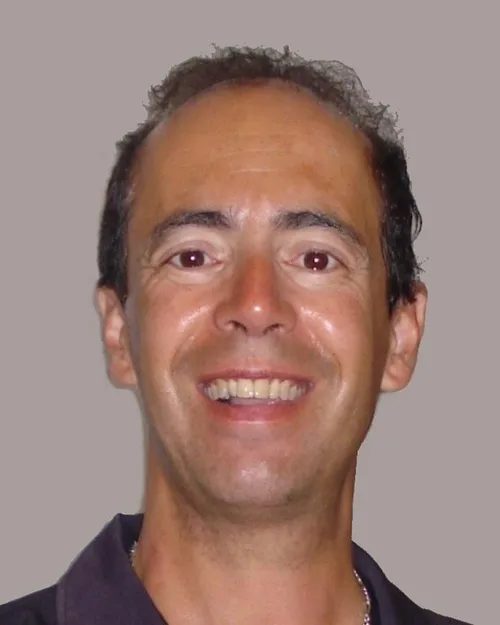
Christophe Giraud - Speaker on geopolitique
Doctor in Geography
Doctor in geography and speaker, I have conducted over a hundred interventions since 2017, mainly on geopolitical topics but also on general knowledge themes.
Need a speaker on these topics?
Frequently asked questions
Which topics does Christophe Giraud cover as a speaker?
Christophe Giraud speaks on the following topics: geopolitique, matieres premieres, sante, sport, religions and langues.
How do I book Christophe Giraud for a conference?
To book Christophe Giraud, contact the Lespeakers agency. An advisor will call you back to scope the event, dates and format.
How much does a conference with Christophe Giraud cost?
Christophe Giraud's fees:
- Conference : 3000 €
Booking is handled through Lespeakers.
Which languages does Christophe Giraud speak on stage?
Christophe Giraud speaks as speaker in french.
Where is Christophe Giraud based?
Here is where Christophe Giraud is based: Bourges.
His conferences
Geopolitics of Raw Materials
Often practiced, the amalgamation of raw materials and energy proves to be unsatisfactory from a semantic point of view, even though they converge on the issue of the energy transition. Examined in their broadest dimension, raw materials play a crucial role in the economy of all countries and, through trade, determine the contours of globalization. Regardless of the fact that the most sought-after raw products have varied throughout history, a major trend is emerging in our time: the increasing pressure on resources, as trivially shown by the examples of construction sand or minerals necessary for the production of fertilizers. In a more focused perspective, metals now represent the most sought-after raw materials with a rapidly growing demand and, for some of them, real risks of shortage in the short or medium term. Often the best endowed, the
Geopolitics of the Internet
Born on American soil, the Internet quickly conquered the world, becoming omnipresent and almost indispensable in our societies. Perceived as virtual, cyberspace relies on perfectly tangible infrastructures, and over the years, the exponential increase in data flows is dizzying. Digital technology is revolutionizing the world of work and reshaping the job spectrum, often to the benefit of the giants of the Net. The question of professional opportunities is addressed, and the ecological impact is examined with data centers. The rivalries between the major powers of the Internet (United States, China, Russia) are analyzed through the functioning modes of the Internet and the cyberattacks that occur in the wake of traditional geopolitical tensions. The initiatives of whistleblowers (J. Assange, E. Snowden) echo the dangers of mass surveillance that has become technically possible.
Geopolitics of Health
The issues related to the health situation of populations have a very long history behind them, marked by crises and advancements. Space, time, and human societies constitute the three dimensions of epidemiological phenomena, and with the consideration of disease vectors, the study of diffusion mechanisms makes the geographer an important interlocutor in the debate. Historically, major epidemics highlight our constant vulnerability, while, on a single strategic ground, health can be analyzed as a weapon or a shield. Since the post-war period, the overall improvement of health situations worldwide cannot mask very deep social and territorial inequalities. During the winter of 2019-2020, the spread of the coronavirus across the planet confirmed the existence of a risk that had been previously diagnosed. With the destruction of ecosystems, wild animals now come into contact with humans, and the fluidity of exchanges, air transport abolishes distances also in health terms. Should economic globalization be reconsidered in light of this crisis? Beyond the indicators, the dangers of variants, should we not question the longer-term changes and, as E. Morin thinks, 'learn to navigate on an ocean of uncertainties'?
Geopolitics of Sport
The phenomena related to sport have recently integrated into the nebulous subjects studied in geopolitics. Round tables on this theme are becoming increasingly numerous, and the educational institution itself has taken up the question. It is true that between globalization and media coverage, sport today benefits from a formidable sounding board that includes and surpasses already considerable economic realities. Perceived as the standard-bearer of 'soft power', athletic achievement is also, very often, the culmination of heavy investments: capitalist logic has long imposed itself on sports fields. The Olympic Games alone summarize all the stakes surrounding sport: a showcase for the success of great powers, they were, even before the Cold War, a major theater of confrontation in the race for medals. Between boycotts (Moscow 1980, Los Angeles 1984) and sharp criticisms of the host country (Beijing 2008), politics is never far from the most famous sporting event on the planet. The World Cup and its formidable audiences establish football as the 'king sport' in most of the world. The growing popularity of the event has never waned since 1930, and the 'Middle Empire' now eagerly observes the prospects surrounding the round ball. The awarding of the World Cup and its organization, which are not always compatible with the sporting ideal, however, provoke fierce controversies that culminated during the 2022 edition in Qatar.
Geopolitics of Religions
Echoing the forecasts of A. Malraux and S. Huntington, a resurgence of religious phenomena characterizes the beginning of the 21st century. The presentation begins with an overview of the major religions: historical divisions and schisms are recalled, and the evolution of the number of believers is observed in detail. Some key concepts (apostasy, creationism, essentialization, ecumenism, secularization...) are also clarified. The geographical dynamics of the distribution of followers for each religion are then examined. Evidently, and independently of the issue of radicalization and the legislation at work in different countries, contemporary religious spaces are becoming more complex. The question of coexistence is viewed in light of migratory movements and the model of large metropolises. A global overview of regions in tension (Middle East, China and neighboring territories, Balkans...) is sketched, introducing some major issues such as those of Eastern Christians or the Rohingyas. Beyond the problem of extremism, the complex links between religion and the political sphere are discussed regarding the weight of religion in the life of states, secularism, ideological confrontations, persecutions, and the perception of blasphemy...
Geopolitics of Languages
As a tool for communication and knowledge transmission, language is by excellence the medium of human cultures. At all scales, the geography of languages expresses a fascinating complexity and richness but also power dynamics that history shows to be constant and renewed. Often unnoticed, linguistic dynamics are frequently marked by confrontation and the law of the strongest, during the era of European powers' expansion as well as today in the realm of scientific publications. From another perspective, is linguistic reality catching up with fiction (1984 by G. Orwell)? Collateral victims of globalization, new technologies, and the dominance of the most widely used languages, 50 to 90% of the languages spoken on Earth are at risk of disappearing in the 21st century, taking with them ancient knowledge. Is it possible to reverse this trend? If so, how?