

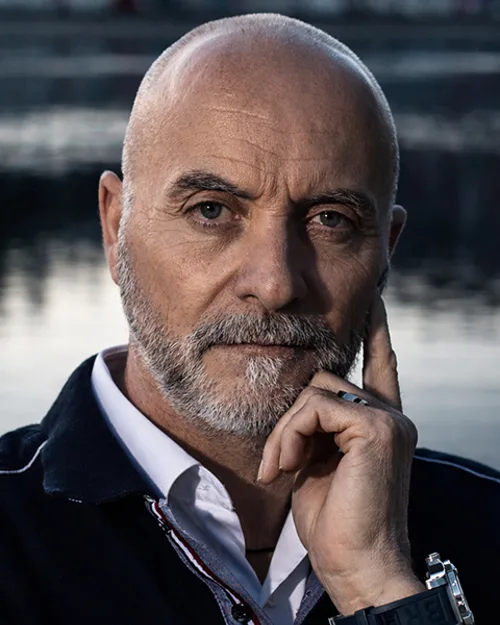
David Hornus - Speaker on gestion de crise
Kidnapping and ransom negotiator - 25 years of experience in economic security and crisis management
I have experienced high-intensity crises from the inside: kidnappings, disappearances, arbitrary detentions, extortion, death threats, post-attack interventions.
I know what happens when the unexpected strikes a company — I have seen the effects of the crisis on organizations, teams, leaders, and sometimes their loved ones.
I developed the concept of Ruddership ® "the exercise of discernment driven by experience" which I express through the Greek approach of Mètis — Mastering, Training, Transmitting, Intervening, Healing.
David Hornus is a specialist in risk governance, economic intelligence, and crisis negotiation. His career began in 1992 with a voluntary commitment for a long service (VSL) of 24 months as a called officer. Following his training as a Reserve Officer Student (EOR) at Saint-Cyr Coëtquidan — whose motto, "the Audacity to Serve", will never leave him, he was assigned to the Marine Infantry. After completing his military obligations, he engaged in humanitarian work. Trained at the Bioforce Institute, he went on missions to Cambodia and then to Georgia, in the Caucasus, between 1994 and 1996 — areas where humanitarian urgency coexists with armed conflict.
Holding a postgraduate degree in economic intelligence strategy from the École de Guerre Économique (1999) and a diploma in "strategies, analyses, and prospects of the Mediterranean worlds" from the University of Toulon (2022), David Hornus founded and led for 18 years one of the first French Security and Defense Services Companies (ESSD) which he had certified ISO 18788 in 2018. For over twenty years he has been protecting his clients against economic crime in all its forms.
As a negotiator within "special risks" insurance policies for a global leader in risk management, he has been deployed on several high-intensity cases where human lives were at stake in complex and degraded environments: kidnappings for ransom, emergency evacuations, post-attack interventions, disappearances, social conflicts…
Read moreRead less
A reserve officer for 15 years, he holds the Volunteer Combatant's Cross for external operations (ex-Yugoslavia, Côte d'Ivoire, Haiti). He is currently an operational reservist in the National Police.
Engaged in the governance of private security companies, David Hornus served from 2019 to 2023 on the board of directors of ICoCA (International Code of Conduct Association), the regulatory and oversight organization for the sector, in Geneva, where he represents the European private security industry.
In 2020, he led a "Territorial Contribution to the Security Continuum", a collective work dedicated to the articulation between state forces, municipal police, and private actors.
From 2020 to 2026, he was the deputy mayor in charge of security for a municipality of over 20,000 inhabitants in the Lyon metropolitan area. David Hornus is one of the few profiles to have practiced security in its four forms — military, humanitarian, private, and local public.
He currently leads the Ruddership Conseil firm.
He is the author of "Danger Zone: testimony of a crisis management professional (Balland 2022) and "Only God Sees It: hostage in the heart of the Syrian crisis" (Balland 2026)
Need a speaker on these topics?
Frequently asked questions
Which topics does David Hornus cover as a speaker?
David Hornus speaks on the following topics: gestion de crise, negociation, securite, leadership and management.
How do I book David Hornus for a conference?
To book David Hornus, contact the Lespeakers agency. An advisor will call you back to scope the event, dates and format.
How much does a conference with David Hornus cost?
David Hornus's fees:
- Conference : 2500 €
Booking is handled through Lespeakers.
Which languages does David Hornus speak on stage?
David Hornus speaks as speaker in french and english.
Where is David Hornus based?
Here is where David Hornus is based: France.
Where does David Hornus speak?
David Hornus's speaking locations: Dans le monde entier.
Which speaking formats does David Hornus offer?
David Hornus offers the following formats: Conférence.
What did David Hornus do before becoming a speaker?
business leader
What led David Hornus to become a speaker?
the desire to share to inspire
Why book David Hornus rather than another speaker?
because I live daily what I talk about and each concrete case in crisis management "special risks" allows me to improve and update my skills and have "up to date" concrete cases.
I am invited because I am one of the few to combine an experience of the most extreme crises, an institutional legitimacy that validates it, and the pedagogical ability to transform it into immediately useful skills.
How does the audience experience a talk by David Hornus?
participation, dynamic pace
Why do organizers like working with David Hornus?
human, accessible. Collaborative spirit
What concrete results can the audience expect after a talk by David Hornus?
a reflection on risks and crises, a methodology around governance and compliance to limit exposure to risks
His conferences
Verbal violence and physical aggression: Preventing, Detecting, Healing. De-escalation techniques and prevention of psychological trauma.
A client raising their voice at the reception. A user who threatens. A collaborator assaulted during a mission, a manager confronted during a social conflict. Violence at work does not warn — but it can be prevented. And above all: it leaves traces, including where one does not look.
David Hornus approaches this subject with a rare dual legitimacy. A field practitioner first: in 25 years of crisis management — social conflicts, post-terrorist attack interventions, kidnappings, degraded situations across several continents — he has learned to read the weak signals of escalation and to defuse before words become blows. An operational reservist of the National Police and former deputy mayor in charge of security, he knows the violence of everyday life as well as that of extreme theaters.
A practitioner of psychotrauma trained at the Centré Compétences school, he knows that an aggression does not stop when the aggressor leaves. It continues in the victim's mind, in the witness teams, in the entire organization if nothing is done. Detecting the signs of trauma, organizing psychological first aid, supporting the return — this is the invisible part of the subject, and it is the one that almost no one addresses.
In this conference, participants learn to act on the three phases of violence: preventing (identifying risky contexts and profiles, establishing a protective framework), detecting (reading escalation signals, applying verbal and physical de-escalation techniques), healing (understanding psychological trauma, reacting in the first hours, avoiding the double penalty of the forgotten victim).
Because protecting one's teams also means supporting victims. And because the employer is obliged to do so — the obligation of safety does not stop when the incident is closed.
From the Security Continuum to Private Military Companies: The Security Paradigm Shift
FROM THE SECURITY CONTINUUM TO PRIVATE MILITARY COMPANIES — Conference by David Hornus**
Conference given on March 14, 2023, at the Lyon campus.
Who really protects today? Between the sovereign state, municipal police, private security companies, and private military companies (PMC), the boundaries of protection are being redrawn — in France as well as in external theaters.
In this conference, David Hornus traces the evolution of the security continuum and sheds light, from the inside, on the reality of private military companies: their history, their legal framework, their real missions — far from fantasies — and the regulatory and ethical issues that traverse the sector.
A rare testimony, nourished by a triple legitimacy: ▪️ Founder in 2003 of the first French "private military company," then leader for 18 years of the Corpguard Group, one of the first French PMCs certified ISO 18788 ▪️ Administrator of the ICoCA in Geneva (2019-2023), the international regulatory and oversight body for private security companies, where he represented the European industry ▪️ Director of a reference collective work, the "Territorial Contribution to the Security Continuum" (2020), and deputy mayor in charge of security (Metropolis of Lyon)
On the agenda: • The security continuum: articulation between sovereign forces, local authorities, and private actors • From "mercenaries" to PMCs: history and legal framework of private military companies • Real missions: protection, training, assistance, crisis management in degraded zones • International regulation and ethics of the sector: the role of the ICoCA • What future for French private security in the face of international competition?
Negotiating is communicating
Discover the fundamentals of negotiation and learn to listen to understand.
We all negotiate every day: a contract, a deadline, a budget, a resolution to a social conflict — sometimes without even realizing it. Yet, few have learned to do so. And even fewer have negotiated when the stakes were not a price, but a life.
David Hornus is one of those. A crisis negotiator deployed on kidnapping for ransom cases within the framework of "special risks" insurance policies, contributor to the documentary "The Ransom" (ARTE, 2017), he has practiced crisis negotiation "in situ".
From this extreme experience, he draws a conclusion: negotiating is not convincing — it is first and foremost listening.
Listening to what is said, what is not said, what the other cannot say. Understanding their constraints before defending your own. Creating a connection before seeking agreement.
In this conference, David Hornus conveys the universal fundamentals of negotiation: preparation, active listening, managing emotions — both his own and those of the other — tempo, and the art of bringing forth a solution that everyone can accept without losing face.
David Hornus is a negotiator in the field of Kidnapping and Ransom insurance. He is the author of Danger Zone: Testimony of a Crisis Management Professional (Balland 2022), a work in which he reflects on 25 years of activity in the field of intelligence and economic security and on the journey that, from his training as a Reserve Officer Student to humanitarian missions in Georgia and Cambodia, led him to work with former FBI negotiators.