

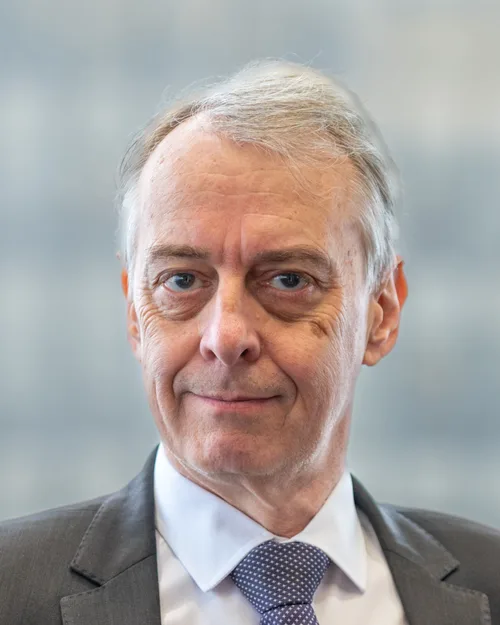
John Crowley - Speaker on transition ecologique
Understanding the challenges of ecological transition and the practical tools to achieve it
John Crowley is the President of the PHGD Group, which brings together various companies active in consulting on environmental and social transformations as well as in renewable energy solutions, notably the Flexeole project for reinventing small wind energy. The Group works closely with two associations chaired by John that deploy the same ideas within a framework of general interest: Catharsis and the French Committee of the Club of Rome.
As a consultant, an internationally recognized expert in sustainable development, he carries innovative tools of trust and common health, serving both territories and businesses. An experienced speaker, equally comfortable in English and French, John offers both technical and general audiences a conceptual and practical understanding of the challenges of ecological transition.
Before founding the PHGD Group in 2021, he spent 18 years at UNESCO, where he led the Research, Policy and Foresight Section from 2014 to 2021. He had previously been responsible for the ethics of science and technology and global environmental change. Before joining UNESCO, he worked as an economist in the oil industry (1988-95) and as a researcher at the National Foundation for Political Science in France (Center for International Studies and Research, 1995-2002). From 2002 to 2015, he was the editor-in-chief of the International Review of Social Sciences, published by UNESCO. He is the author of several books and about a hundred articles and chapters of academic works.
Read moreRead less
As a speaker in his various fields of intervention, John emphasizes highlighting the connections between the frameworks of understanding the world - sometimes abstract, even unconscious - and the practical capacities to act within it. Climate change is exemplary: a prospective and probabilistic analysis framework, derived from highly complex interdisciplinary sciences, it is at the same time a subject of public debate and political controversy. It is important to grasp what it means, in both senses of the term: the meaning it has, and the consequences it implies. In line with his consulting practice, John extends this approach to all fields of ecological transition, emphasizing the necessity of thinking them in an integrated manner.
Here is the list of conferences he has given in 2024-26, on ecological transition as well as on other subjects for which his expertise is internationally recognized.
March 20, 2024, "The museum of the future", Apheleia Annual Meeting, Mação, Portugal July 13, 2024, "The path to a Culture Goal", Kaustinen Folk Music Festival, Finland September 20, 2024, "Science, technology and the human condition", University of the Chinese Academy of Sciences, Beijing, China September 21, 2024, "Shadows of the past, shadows of the future", Congress of the 75th anniversary of the International Council of Philosophy and Human Sciences, Beijing, China October 24, 2024, "Traces of the South", University of Evora, Portugal February 27, 2025, "Generalizing Capital", Apheleia Conference Series (remote intervention) April 8, 2025, "Does culture need its own SDG?", Apheleia Annual Meeting, Mação, Portugal (master of ceremonies) June 16, 2025, Symposium "The butterfly effect - sustainable food", Boulogne-Billancourt (master of ceremonies) September 27, 2025, "The Culture Goal: from necessity to reality", Mondiacult Conference of UNESCO, Barcelona October 7, 2025, "The fluid dynamics of culture", Academy of the International Council of Philosophy and Human Sciences, Excelia School, Cachan October 29, 2025, "Open science in theory and practice", European Informatics Leaders Summit, Rennes January 12, 2026, "The SDG Culture: from necessity to reality", Meeting of the Canadian French Cultural Federation, Ottawa March 23, 2026, "Imagination and Possibility", Apheleia Annual Meeting, Mação, Portugal May 7, 2026, "Rethinking management education in the face of artificial intelligence", Excelia School, Tours May 12, 2026, "Ageing as a comprehensive social challenge", 9th Geriatrics and Gerontology Course, Ankara, Turkey (remote intervention)
Need a speaker on these topics?
Frequently asked questions
Which topics does John Crowley cover as a speaker?
John Crowley speaks on the following topics: transition ecologique, environnement, transformation, valeur and transition energetique.
How do I book John Crowley for a conference?
To book John Crowley, contact the Lespeakers agency. An advisor will call you back to scope the event, dates and format.
How much does a conference with John Crowley cost?
John Crowley's fees:
- Conference : 2500 €
Booking is handled through Lespeakers.
Which languages does John Crowley speak on stage?
John Crowley speaks as speaker in french and english.
Where is John Crowley based?
Here is where John Crowley is based: Paris.
What did John Crowley do before becoming a speaker?
I have always been a speaker: as a university researcher, as an international civil servant, today as an entrepreneur of ideas and technologies, public speaking and transmission have always been essential.
Why do organizers like working with John Crowley?
I am friendly and approachable, very reliable in my commitments (I would never cancel because I have a better offer), flexible in the face of technical and logistical constraints.
His conferences
Measuring the Invisible to Succeed in the Ecological Transition
If the ecological transition appears costly - perhaps too costly in the eyes of some for them to be willing to engage in it - it is because its costs and benefits are poorly measured. Essential elements of economic calculation, particularly natural capital, are most often completely overlooked. Yet the tools exist, both technical and conceptual. And when we use them, we are better able to assess the costs and benefits of engaging in the ecological transition.
To understand this, it is important to focus on four questions.
How, traditionally, do we integrate elements of natural capital into public and private accounting? Answer: we do not, just as we do not integrate human capital.
What tools do we have today to do better? Answer: powerful and technically sound approaches that allow us to appreciate the value, for example, of ecosystem services based on the human and technological costs they avoid.
How, in practice, do we use such tools? Answer: it is complicated, because we can only define something as "capital" if we assign someone the responsibility for its creation and maintenance. Taking the notion of natural capital seriously opens the complex and essential debate on the legal status of non-human entities. But fortunately, we can make concrete progress without having to solve everything.
Does assigning an economic value to non-human entities pose a problem? Answer: yes, if that is all we do. Indeed, economic value is only one dimension of value, which itself can only be understood through the values that make certain things appear important or precious to us. Fully thinking about the ecological transition means equipping ourselves with technical valuation tools, while never forgetting that they are just tools.