

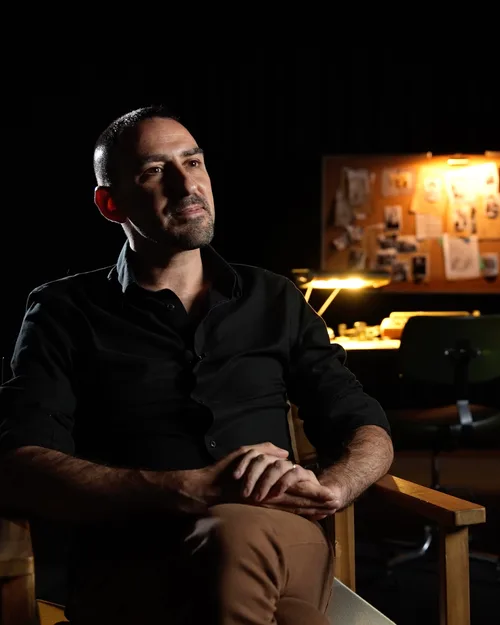
Ludovic Richer - Speaker on histoire
Specialist in myths and religious facts in history, I study esoteric beliefs and traditions.
My name is Ludovic Richer, author, videographer, and speaker specializing in the study of the history of civilizations and religions, mythology and folklore, as well as the history of esotericism and occult sciences. Creator of the YouTube channel 'Arcana – The Mysteries of the World', which today has over 300,000 subscribers, I have been developing historical and symbolic content for several years aimed at a wide audience. My work is based on a rigorous approach combining research, popularization, and exploration of cultural heritage. I have been active in this field for over nine years, during which I have produced more than 400 videos and published two works: Arcana – The Mysteries of the World: The Forgotten Civilizations and Arcana Mundi: The Initiatory Rites. I regularly speak at conferences for associations and municipalities to explore the links between myths, history, and beliefs. I believe I can provide tools to address complex topics — particularly the religious fact, beliefs, and representations of the past — in an increasingly fragmented society. My experience in popularization on YouTube and social media has taught me to handle these sensitive themes with rigor, nuance, and pedagogy, while making them accessible to a wide audience. I can help distinguish established knowledge from pseudo-historical or archaeological beliefs that circulate massively online today, and develop a solid critical method. My transdisciplinary background, combining history, mythology, religious sciences, esotericism, and symbolic analysis, shows that it is possible to study spiritual and esoteric domains with the tools of the historian, anthropologist, and psychologist, without yielding to sensationalism or ideological distortion. In short, I wish to convey to them a way to explore ideas, traditions, and imaginaries with precision, method, and openness, so that they can understand and analyze the contemporary world with greater perspective and discernment.
Need a speaker on these topics?
Frequently asked questions
Which topics does Ludovic Richer cover as a speaker?
Ludovic Richer speaks on the following topics: histoire and spiritualite.
How do I book Ludovic Richer for a conference?
To book Ludovic Richer, contact the Lespeakers agency. An advisor will call you back to scope the event, dates and format.
How much does a conference with Ludovic Richer cost?
Ludovic Richer's fees are provided on request through Lespeakers.
Which languages does Ludovic Richer speak on stage?
Ludovic Richer speaks as speaker in french.
Where is Ludovic Richer based?
Here is where Ludovic Richer is based: Limoux.
His conferences
At the Crossroads of Beliefs: Can We Still Talk About Religions?
At the crossroads of beliefs, followers of different religions find themselves in a complex situation where dialogue sometimes becomes difficult, even violent. Why is this the case? The answer partly lies in the sometimes contradictory dogmas that characterize different religions such as Christianity, Islam, Judaism, Buddhism, Hinduism, Taoism, and many others... Yet, despite these differences, there are many synchronicities among these various beliefs around the world. They all share common quests: that of individual salvation, world peace, and a life filled with values and meaning... However, deep differences remain and lead to conflicts, such as the conception of one or multiple gods, or the absence of divinity, the position of women on a theological level, or even dietary and behavioral prescriptions that are sometimes antinomic... Furthermore, the modern world and scientific advancements have largely called into question the stances of historical religions, highlighting: the dark aspects of their histories (persecution of pagans, heretics, atheists, etc...), the historical fragility of religious narratives (the flood myth, the lives of patriarchs, inconsistencies with scientific knowledge, etc...), the moral constraints of religions from another age that are no longer adapted to the sociology of the 21st century (notably regarding the place of women, individual freedom, sexuality, etc...). This phenomenon has given rise to several trends: the emergence of new spiritualities, freed from old dogmas, the rise of anti-religious militancy, the radicalization, both verbally and physically, of certain believers belonging to historical religions. In the face of these challenges, the crucial question arises: how to restore a constructive dialogue between believers of different religions, atheists, and followers of modern spiritualities? This is the complex subject we will explore during this conference, in search of ways to promote mutual understanding and peaceful coexistence.
Is History Written by the Victors? - The History Factory
Here is the issue: "History is written by the victors." Indeed, this is a fact, but if the victors had not written about the vanquished, we might not even know of their existence.
The questions: Are we completely neutral when it comes to historical questions? Is the teaching of history aimed at better understanding the past, or at promoting a chosen vision of the past? Is our current knowledge of history reliable?
This episode of "Update" will address the vast question of "understanding history", its prisms, its weaknesses, its deviations, and especially its variables. History is undoubtedly one of the best propaganda tools, allowing one ideology to be highlighted over another.
It will be a journey through the meanders of: romantic history, ideological history, politically correct history, pseudo-history, academic history, popular history, the history of history, historical popularization, imagined history, and real history, if it is indeed accessible.
Non-exhaustive examples of issues:
The study of the Crusades is not presented the same way in the 1930s as in the 1990s: why? What are the explanatory models? Who is right, who is wrong? The study of ancient civilizations challenges the biblical narrative: is the revelation false? Are historians trying to destroy religion? What is the impact on our view of the past? The morals and social conditions of ancient societies are different from today: can we analyze history objectively with our modern perspective? Are archaeologists operating within an ideological prism, yes or no? What about alternative researchers? The Romans deliberately demonized the Gauls: why, and what do we really know about the Gauls today? Did Atlantis really exist: Is the question well posed? What are we really looking for?
Occultism and Secret Societies in the Belle Époque
The Belle Époque, a period of prosperity and cultural effervescence extending from the end of the 19th century to the beginning of World War I, also marks the golden age of occultism. As scientific advancements shake the world, a growing fascination with the mysteries of the invisible emerges, driven by a desire to penetrate what escapes reason. It is an era where esotericism, spiritualism, and secret societies intertwine in a quest for meaning and spirituality.
Thus, I invite you to dive with me into this golden age of Occult Sciences, meeting the great figures of the time: Stanislas de Guaita, Papus, Samuel and Moina Mathers, Aleister Crowley, Dion Fortune, and many others. Together, we will cross the thresholds of the initiatory societies of this era to explore their goals, rituals, and beliefs, beyond the myths and fantasies that surround them.
Monsters in History: Why Do They Haunt Our Imagination?
"Throughout the ages and cultures, monsters have haunted the human imagination, embodying both our ancestral fears and beliefs. This conference explores their role in history and their evolution, revealing what they say about our relationship with the world and ourselves."
Minotaur, mermaid, dragon, vampire, and other creatures populate the world of legends. From ancient mythologies to medieval folklore, to modern works of fiction, monsters have always accompanied humanity, evolving over the centuries while maintaining a central place in our beliefs and narratives.
But why, in all times and cultures, have we felt the need to create this fantastic bestiary?
Is it an illustration of our ancestral fears and the unknown?
Isn't the monster, above all, the one who stands on the margins of civilization?
Or does it embody our own inner demons, lurking in the depths of our unconscious?
Thus, we will travel through a complex universe, where religion and superstitions intersect, in a space where men and monsters coexist, at the border of the imaginary and history, giving birth to the most fascinating figures of our cultural heritage.