
Martin Duval - Speaker on intelligence collective
Co-Founder & Co-President of bluenove - Author
Co-President & Co-Founder of bluenove, a software technology and consulting company based in Paris specialized in Massive Collective Intelligence and Open Innovation, which he started in 2008. With a team of 50, bluenove has delivered over 500 projects to more than 200 customers. Check: www.bluenove.com
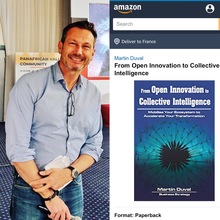
He is the author of the book "From Open Innovation to Collective Intelligence" available here in English https://www.amazon.com/Open-Innovation-Collective-Intelligence/dp/1072313472 and here in French (published by Dunod) https://www.dunod.com/livres-martin-duval
Read moreRead less
From 2001 to 2008 at Orange, he held various positions in innovation and business development. In 2006, he created the 'Orange Start Up Programme' to foster partnerships with start-ups and VCs focusing on WEB 2.0 and convergence. From 2003 to 2006, as Bus.Dev. Director at Orange France, he launched various projects, most of them being worldwide or European premieres such as the emergency location services for senior users (e.g., Alzheimer bracelet from Medical Intelligence), the M-coaching quit-smoking SMS program, the SMS Juke Box, etc. Additionally, he managed the fast-growing Mobile Music activities within Orange France, including the launch of the Music Portal and the Full Track Download services, thus developing strong relationships with the Majors. From 2001 to 2003, he managed the Orange incubator (Inventmobile) focusing on innovative mobile services: among them was Mobivillage valued from €1.5M in 2001 to €15M when acquired by the Japanese company ForSide in 2004. He has been in the area of high-tech early-stage financing since 2000: first as COO of a French incubator and then as Managing Director of the Swedish fund Speed Ventures in France. Prior to that, he spent 3 years in consulting as Senior Project Manager at Cambridge Technology Partners. From 1996 to 1997, he was International Business Development Manager for the Accor Group. He started his career in 1990 in the aerospace industry with Eurocopter (EADS Group), first in Procurement in the USA (Dallas) and later as Area Sales Manager of Commercial helicopters in Northern Europe before starting his own business in aircraft financing services.
Need a speaker on these topics?
Frequently asked questions
Which topics does Martin Duval cover as a speaker?
Martin Duval speaks on the following topics: intelligence collective, open innovation, innovation, management, agile, transformation, collaboration and economie circulaire.
How do I book Martin Duval for a conference?
To book Martin Duval, contact the Lespeakers agency. An advisor will call you back to scope the event, dates and format.
How much does a conference with Martin Duval cost?
Martin Duval's fees:
- Conference : 3500 €
Booking is handled through Lespeakers.
Which languages does Martin Duval speak on stage?
Martin Duval speaks as speaker in french and english.
Where is Martin Duval based?
Here is where Martin Duval is based: Paris.
His conferences
Innovation Strategy: How to Transition to a Circular Economy?
Professor Clayton Christensen in his book "The Innovator's Dilemma" published in 1997 already highlighted the notion of a dilemma regarding a company's ability to choose between incremental innovation and disruptive innovation. In the context of this dilemma, incremental innovation is often more attractive for established companies as it improves existing products or services and meets current customer and market expectations. It is a safer and more predictable approach that can generate short-term profits. Disruptive innovation, on the other hand, involves creating new markets, new business models, and disrupting existing markets. It is a riskier and more uncertain approach that may not always generate immediate profits and can even cannibalize existing product sales. However, if successful, disruptive innovation can provide a significant competitive advantage and create substantial long-term value. To bring forth this idea of a "double dilemma" between Incremental versus Disruptive Innovation and objectives oriented more towards Performance than towards the Planet (including ecological and human dimensions), I propose the following matrix: . Quadrant 1 (Incremental Innovation, Performance Orientation): These companies focus on the continuous improvement of their existing products and services, with an emphasis on financial performance. Their innovations primarily aim to increase efficiency and profitability. . Quadrant 2 (Disruptive Innovation, Performance Orientation): These companies seek to disrupt existing markets and create new markets, always with a focus on financial performance. Their innovations may be risky, but they have the potential to generate high returns. . Quadrant 3 (Incremental Innovation, Planet Orientation): These companies focus on the continuous improvement of their existing products and services, but they place great importance on environmental and social considerations. Their innovations aim to make their activities more sustainable and minimize their negative impact on the planet. . Quadrant 4 (Disruptive Innovation, Planet Orientation): These companies seek to disrupt existing markets and create new markets with a focus on sustainability. Their innovations may be risky, but they have the potential to create significant value for both the company and the environment. We could thus envision eight types of company profiles (which I have created names for), each corresponding to a specific quadrant or straddling two quadrants: 1. The Optimizers (Quadrant 1): These companies focus on optimizing their existing products and services to improve financial performance. They prioritize incremental innovations and are generally oriented towards mature markets. 2. The Disruptors (Quadrant 2): These companies are oriented towards disrupting existing markets and creating new markets. They emphasize disruptive innovation with a strong potential for return on investment, but they tend to neglect environmental and social considerations. 3. The Eco-Innovators (Quadrant 3): These companies seek to incrementally improve their existing products and services while integrating ecological and social considerations. They strive to innovate in a way that minimizes their negative impact on the environment and maximizes their positive contribution to society. They rather apply a weak circularity model. 4. The Visionaries (Quadrant 4): These companies focus on disruptive innovation with an emphasis on sustainability. They seek to disrupt existing markets and create new models oriented towards strong circularity. 5. The Transitioners (between Quadrant 1 and 3): These companies seek to balance incremental improvements of their existing products and services with ecological and social considerations. They try to maintain a balance between financial performance and sustainability. 6. The Transitioning Disruptors (between Quadrant 2 and 4): These companies are engaged in disruptive innovation with a strong emphasis on sustainability, while trying to maintain solid financial performance. They seek to create new environmentally and socially respectful markets while achieving satisfactory returns on investment. 7. The Transformers (between Quadrant 1 and 2): These companies are transitioning from a performance optimization approach through incremental innovations to an approach centered on disrupting existing markets and creating new markets, but do not prioritize CSR. 8. The Eco-transformers (between Quadrant 3 and 4): These companies are transitioning from an approach centered on incremental eco-innovation to an approach centered on sustainable disruptive innovation. They seek to transform their business model to create new models of strong circularity. The names of the different profiles are prone to disagreements and even controversies, but they matter little in themselves and can be modified to the taste of the company that wishes to use them. The matrix of the innovator's double dilemma can be used by companies both to assess their current position, define their desired position, and plan their transition trajectory. It can help them identify opportunities and challenges related to their current position, understand the implications of their desired position, and design strategies and actions to bridge the gap between the two. It can also be used to facilitate dialogue and decision-making among the various stakeholders of the company (management, employees, customers, suppliers, investors, etc.).
TRANSFORMATION: the more we are, the faster we go!
✅ It is now accepted by the majority of organizations that any transformation process must integrate a "good dose" of collaboration to succeed. ✅ However, it is still perhaps counterintuitive to think that "The more we are, the faster we go!". ✅ Moreover, organizations often face the dilemma of "employees already too solicited (by questionnaires, surveys, barometers)" versus "the observation that team engagement levels are declining". ✅ This paradigm and dilemma is what this presentation invites us to explore by proposing 12 methodological and technological biases and solutions to reinitiate new participation dynamics in the service of engagement.
How to mobilize, animate, and analyze collective intelligence?
Based on my book "From Open Innovation to Collective Intelligence" (Dunod) https://www.dunod.com/livres-martin-duval (a copy will be provided to you), I propose a sharing and exchange for one hour (30/45 minutes of presentation + 15/30 minutes of Q&A), in 1to1 (individual training) or 1toMany (seminar/event) on the main methodological and technological principles and the key success factors to prepare and succeed in a co-construction approach (strategic plan, purpose, innovation roadmap, transformation issues, culture & values, etc.) for a large number (several hundreds or thousands of participants) in a few weeks.
How to Mobilize the Collective Intelligence of Employees During the Crisis
(30-minute format in digital remote: Zoom, Klaxoon, Teams, etc.) Should we engage our employees during the lockdown, afterwards, or not at all? Should we ask them about their experience of the crisis or about the future? With open or closed questions? And how to manage communication with managers? At what pace? Etc. These are just some of the questions this Talk aims to address. In light of current cases (March/April 2020) of the use of methodologies, technologies, and platforms from bluenove by its clients, here is what I perceive as the current stances to best mobilize the collective intelligence of all employees and managers during this unprecedented Covid-19 crisis, including lockdown and post-lockdown periods. 1) We cannot do nothing. The medium/long-term uncertainty of the crisis's impact on a company's future (its business model, its purpose, its strategic positioning, its brand, etc.) is compounded by the short-term uncertainty regarding the experience of confinement (what we have learned individually and collectively). Added to this is the uncertainty about the end of confinement: what about the conditions for
My 5 Keys to Successfully Facilitate Your Round Table
I am sometimes invited as a Speaker at seminars and conferences, but the exercise I particularly love is preparing and facilitating a round table. I often say that I prefer to 'demonstrate my expertise through the intelligent questions I ask others' rather than presenting it in the format of a 30 to 40-minute monologue.
From the experience I have accumulated in this exercise, here are some key success factors to consider, in my opinion, to successfully create that famous sauce, a tasty blend of fluid interactions and exciting themes, appreciated by the various stakeholders involved, which are:
The sponsor organizing the event: a company for its seminar or a communication agency for its client, whose goal is to successfully execute one of its highlights of the day by presenting credible or even emblematic experts, addressing topics as exciting as possible with maximum interest, satisfaction, and impact on the gathered audience. All this with perfect time management, always constrained by other interventions and presentations scheduled before and after the round table. The audience, of course: invited or registered participants who have taken their precious time to attend and who expect to discover and learn new things through a dynamic format, made up of exchanges and sharing between and with recognized experts. The speakers: generally selected by the event organizers for their expertise and legitimacy related to the theme addressed by the round table. When I can still do it in advance, I generally recommend not exceeding 3 to 4 speakers. The facilitator of the round table: who may or may not be an expert themselves on the theme addressed. Two key steps for the facilitator's job: preparation in advance and the facilitation itself. I sometimes propose a 3rd step that I appreciate, which consists of writing a report or summary published on the bluenove blog or on LinkedIn as a post-event step and contribution with content intended to last beyond the event.
- Preparation in advance: once the contact details of the speakers are collected, I prepare a proposal by email of the plan and key questions that I send to them through an email addressed to all, in which I ask them to propose a time slot for an individual phone call of 15 to 30 minutes to follow. During this call, I validate with them my proposed guiding thread and key questions.
- Balance between preparation and spontaneity: during this call with the speakers, I certainly indicate the key questions I am about to ask them and the timing associated with each step, but I also warn them that I will seek to maintain maximum spontaneity on their part and create exchanges between them. I invite them not to hesitate to bounce off each other's answers and warn them that depending on the evolution of the exchanges between them, I allow myself to add other questions. What I seek to avoid here is a series of interventions of 5 to 10 minutes one after the other, which would be perceived as mini-prepared monologues without spontaneous exchanges between the speakers. Note that I try to avoid the presentation of slides, or at most 1 or 2 if a participant insists.
- The ideal format: 1 hour with 40 minutes of exchanges between the speakers and 20 minutes of exchanges with the room. It is essential to leave enough time for questions posed by the participants in the room. Here too, it is about playing the role of facilitator so that questions and answers are short, to allow time to address as many as possible. After a quick introduction on the theme, no more than 5 minutes to set a clear framework and objectives, I quickly present the participants before asking my first question to one of them. At the end, I make sure to mention them again (sometimes by their first names when sufficient empathy has developed) and thank them, stimulating applause from the room, which I also thank.
- The arrangement of seats: a logistical detail, I prefer a semicircle that puts the speakers facing the participants, and I position myself rather on one side, slightly orienting my seat towards them, while keeping a sufficiently open angle towards the room. I perceive that my role is primarily to highlight the invited experts to the audience. I also ensure that a sufficient number of microphones are made available .. and that they work!
- Between kindness and impertinence: during the questions and exchanges, I strive to build trust with the speakers in the natural continuation of the prior preparation. A kind tone remains the absolute priority. However, I try to revive the discussion on angles that begin to appear more divisive or even sensitive, being careful not to fall into controversy or intentional difficulty: I indeed bet that the audience appreciates unexpected and rare passages, which give rise to lateral viewpoints in which wooden language is completely absent, while maintaining a kind and constructive spirit.
Ready to successfully facilitate your next round table?
The Manifesto of "Deciding Differently" through Collective Intelligence
On the issue of "Deciding Differently", I have written in the form of a Manifesto what seems to me to be the fundamentals of a new paradigm of modern organizational management and a new era of decision-making. See you soon to discover the details at your event or seminar...
- By choosing the right methods and technologies, you will establish a relationship of trust by and for the collective.
- You will prove that widely consulting on strategy does not mean that one does not master its course.
- You will believe in massive, digital, transverse, and multidisciplinary conversation.
- You will reassure through the transparency of the approach.
- You will not commit to doing everything.
- You will motivate through the clarity of the objective of the final deliverable.
- You will animate through the engagement pyramid.
- You will create insights through the variety of uses and analyses of collective intelligence.
- You will inspire through narrative, utopia, and imagination.
- You will succeed through the hybridization of digital and in-person.
- You will impact through speed and short cycles.
- You will embrace consensus and divisions.
- You will rely on collective intuition.
- You will reinvent project mode and collective action.
- You will manage the collective courage to stop, add, and accelerate projects.
- You will illustrate digital transformation.
- You will co-construct and embody the purpose of your organization.
- You will mobilize all stakeholders in your ecosystem.
- You will innovate in the mobilization of collective intelligence.
- You will establish new dimensions of leadership and management skills.
How many of these could your company, your management, or you check off? 'Life (and collective intelligence!) is a journey, not a destination'...
How to be agile ... with 100,000 in 3 months?
Agile methods from the IT world have truly transformed traditional project management: short cycles through sprints, frequent reprioritization of ongoing developments, task complexity assessment systems, etc. are particularly well-suited for collaboration among small teams, typically consisting of 10 to 15 participants, in a commando mode. But what happens when it comes to tackling a key issue within a large organization, with the conviction that it will only be resolved through the collective intelligence of thousands of minds and that the rapid implementation of these solutions will require an extraordinary level of ownership? What agile methods can be proposed to address a strategic, transformational, or societal issue, mobilize several thousand potential contributors, align them on the problem, share new ideas, then deepen them together and finally prioritize them before producing a final deliverable in response to the posed challenge? In short, what would massive agility with 100,000 participants mean within a large company? My presentation will particularly address a set of non-exhaustive conditions and ingredients to be anticipated for this true 'scaling up' of agility: 1) The use of digital technologies capable of enabling simultaneous or asynchronous interactions among several thousand participants and, on the other hand, the data analysis of the new knowledge co-created at high speed 2) The strong methodological bias that new ideas will emerge from conversations among participants and that, in this respect, the 'discussion thread' of the Forum type must remain at the heart of the system 3) The cycle time of such a massive sprint, which we can rather call 'debate' or 'consultation', must also remain proportionally short to be effective: this large ephemeral community should indeed not be mobilized on a specific issue for more than 8 to 10 weeks 4) The harmonious hybridization between methodology and software as a fundamental conviction: a massive agility approach must traverse several methodological phases (collective appropriation of the issue, ideation in the form of conversations, deepening of concepts through various criteria, prioritization through tokens), themselves very agile in the progressive choice of their phasing, while the interface of the online platform adapts and evolves as these different types of interactions are proposed to participants 5) The nature of a final and concrete deliverable must be clearly established from the outset of the process. The successive steps of the process, up to the decision-making phase to follow, must also be communicated sincerely and transparently throughout the process. Yes, these new forms of massive agility already exist and are used by leading organizations and companies (EDF, Société Générale, Engie, Sncf) that are convinced that the future of their performance lies in the ability to better mobilize the collective intelligence of the stakeholders in their ecosystem.
From Open Innovation to Collective Intelligence
I am the Co-Founder & Co-President of bluenove, a technology and consulting firm, with a team of 50, pioneer in collective intelligence, a leader in open innovation and an active player in CivicTech. I am also the author of "From Open Innovation to Collective Intelligence" published in French by ReachPublishers in May 2019 and available here on Amazon > ........................... (in French version on Amazon > https://amzn.to/2HwydSd)
I would have 5 things to share:
- The last trends in Open Innovation and an ecosystemic vision of innovation management
- What is "Massive and digital collective intelligence" and why this is going to become THE next big skill of a new paradigm of leadership and performance for major public and private organizations
- The description of a new methodology and platform from an R&D program from The European Commission (Assembl) which enables a) to tackle a specific strategic, transformational or social issue b) to mobilize and manage a very big group of participants (from few hundreds to tens of thousands) c) to co-create an impactful decision-making final deliverable (action plan, series of recommendations, manifesto) d) in a short time (2 months)
- All the above illustrated by many examples and concrete cases from major corporations and public bodies
- Various points of view thanks to my background in major corporations (Airbus, AccorHotels, Orange), my experience as an entrepreneur (bluenove) and my ability to story tell it as an author.
From Open Innovation to Collective Intelligence
I am the Co-Founder and Co-President of bluenove, a technology and consulting company with 50 people, a pioneer in collective intelligence, a leader in open innovation, and a committed player in CivicTech. I am also the author of "From Open Innovation to Collective Intelligence" available on Amazon > https://www.amazon.fr/Open-Innovation-Collective-Intelligence/dp/1072313472
I have 5 things to share:
- The latest trends in Open Innovation and an ecosystemic vision of Innovation
- What is "massive and digital collective intelligence" and why it will become THE new key skill of a new paradigm of leadership and performance for large public and private organizations and a new way to decide and act within organizations
- The description of a new method and platform resulting from R&D by the European Commission (Assembl) that allows a) addressing a strategic, transformational, or societal issue b) mobilizing and engaging a very large number of participants (from a few hundred to several tens of thousands) c) to produce an impactful deliverable (action plan, series of recommendations, manifesto) d) in a short time (2 months)
- The illustration of the whole by numerous examples and concrete cases from large groups and public actors
- Various analytical perspectives thanks to my background in large groups (Airbus, AccorHotels, Orange), my entrepreneurial experience (bluenove), and my work in synthesis and storytelling as an author.