

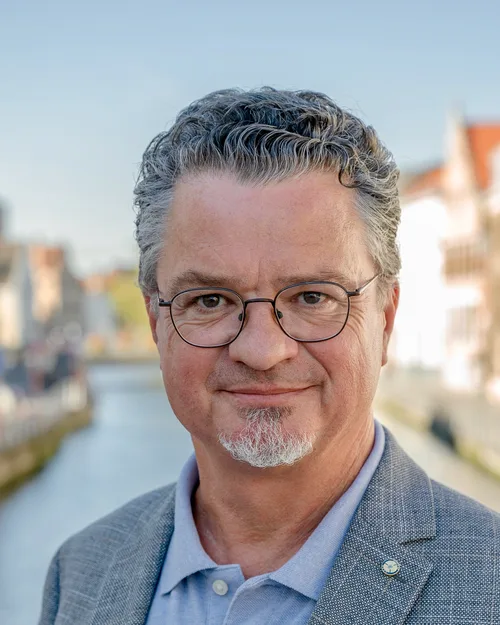
Olivier Costa - Speaker on europe
Olivier Costa is a political scientist, specializing in European integration, international issues, and political life. He is a CNRS research director at CEVIPOF (Sciences Po).
Olivier Costa is a political scientist, specializing in European integration, international issues, and French political life. He is a CNRS research director at CEVIPOF, the political research center of Sciences Po (Paris).
He studied at Sciences Po Strasbourg and then dedicated his doctoral thesis to the functioning of the European Parliament (University Paris VIII, 1998). Initially a researcher at the Free University of Brussels, he joined CNRS in 1999.
His research and publications focus on the institutional system and policies of the European Union, as well as the institutions and actors of parliamentary representation in Europe and France. He is the author of 10 books, has directed 25 collective works and special issues of journals, and has published nearly 200 articles and chapters of scientific works.
He teaches European issues at Sciences Po, within the School of Public Affairs. He has been a visiting professor at numerous universities in Europe, the United States, and Japan. He is also involved in ongoing training on European issues for various audiences (senior officials, diplomats, private sector executives, lobbyists, journalists, business leaders...).
He works as an expert for the European Parliament, the European Commission, French authorities, and think tanks. He is also a consultant for various public and private organizations. He regularly appears in the media on his favorite topics: institutions and policies of the European Union, French political life, international issues.
He is a speaker and APM expert.
In his spare time, he writes columns (under the pseudonym Oscar Vileito) and draws classic cars.
Need a speaker on these topics?
Frequently asked questions
Which topics does Olivier Costa cover as a speaker?
Olivier Costa speaks on the following topics: europe, geopolitique, strategie, negociation and gestion des conflits.
How do I book Olivier Costa for a conference?
To book Olivier Costa, contact the Lespeakers agency. An advisor will call you back to scope the event, dates and format.
How much does a conference with Olivier Costa cost?
Olivier Costa's fees are provided on request through Lespeakers.
Which languages does Olivier Costa speak on stage?
Olivier Costa speaks as speaker in french.
Where is Olivier Costa based?
Here is where Olivier Costa is based: Saint Médard En Jalles.
His conferences
Lobbying in the European Union: Current State and Strategies
Brussels is the second city in the world in terms of the number of lobbyists, due to their very intense presence around the institutions of the European Union.
Why are they so present? What is their influence? Are European institutions really more open to lobbying than national institutions? What are the rules in force in Brussels?
How can a company, an association, or a union defend its interests in Brussels? What are the golden rules of lobbying at the European level?
Negotiating by Drawing Inspiration from European Institutions
For 75 years, the institutions of the European Union have overcome national and political divisions to find broad consensus.
What negotiation techniques are employed at the European level?
This conference, based on 25 years of research and collaboration with European institutions, outlines the specifics of decision-making and negotiations within the Union.
It particularly presents the techniques that have been developed to overcome deadlocks and generate consensus ("package" negotiations, "declarations", compromises, "appointment clauses", depoliticization, primacy of expertise, opt-out...).
These tips can be usefully transposed to other contexts of difficult negotiations.