
Sébastien Bichon
Transforming obstacles into competitive advantages. What if your teams learned to remain effective even when conditions are not ideal?
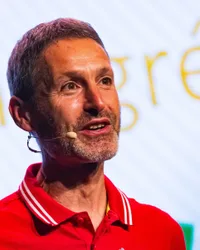
Speaker and author, I hold a strong belief: performance does not always arise from comfort. Having lost a leg at the age of 4, I understood early on that it is not just the starting conditions that make the difference, but the way we look at them, how we adapt to them, and how we transform them. A Paralympic medalist in para-cycling at the Sydney 2000 Games, multiple French champion, bearer of the Olympic flame in 2024, I have also undertaken several extraordinary challenges: • Crossing France by bike solo and self-sufficiently in 1994. • 1300 km on a mountain bike in 21 days and solo in southern Morocco in 1999. • Double ascent of Mont Blanc: 2016 and 2019. • 1200 km by bike in less than 5 days during Born To Ride 2020. • World first in 2021 by guiding a visually impaired person by voice in the ascent of a mythical pass, each alone on their bike. But my expertise does not only lie in these experiences. It lies mainly in what they have taught me: • to remain engaged when everything becomes difficult, • to transform a constraint into a lever for action, • to move forward without waiting for ideal conditions, • to make the collective a force for progress. Today, I work in companies to help teams transform their challenges into opportunities for action, progress, and performance. TOPICS • Transforming challenges into opportunities • Sustainable performance • Team engagement • Strength of the collective • Diversity as a lever for performance

Prices
- Conference : 4500 €
Localization
Languages
My conferences
Transforming the obstacle into a competitive advantage
What if the problem wasn't the obstacle... but the way to look at it? In a world where companies must deal with uncertainty, pressure, and constant transformations, how can we maintain engagement, performance, and cohesion when everything doesn't go as planned? Through my journey as an amputee, Paralympic medalist, and adventurer, I share the lessons I've learned from situations where conditions were rarely ideal. A concrete approach that is directly transferable to the business world to: • Transform challenges into opportunities for progress. • Maintain a high level of engagement over time. • Develop a solution-oriented mindset rather than one focused on obstacles. • Make the collective a factor of performance. • Move from reaction to action in the face of the unexpected. An inspiring and concrete conference that shows that performance does not solely depend on the conditions of the moment, but also on what we decide to make of it. Your collaborators leave with: • A new way to approach difficulties. • Concrete keys to remain engaged over time. • A strong awareness of their capacity for action. • The desire to dare, to decide, and to take action. • A better ability to transform obstacles into levers for action.
Learn more
Who am I?
What I did before becoming a speaker
I worked for 17 years at Macif. Alongside my professional activity and my career as a high-level athlete, which notably led me to win a bronze medal at the Sydney Paralympics, I was already volunteering to share my experience with associations, schools, and various organizations. Sharing knowledge was already part of my daily life long before I made it my profession.
What made me become a speaker
Initially, I did not plan to become a speaker. I was volunteering to share my experience as a Paralympic athlete and an amputee. Over time, I noticed that my journey allowed participants to view their own challenges, obstacles, or limiting beliefs differently. I then understood that beyond personal stories, there were universal lessons that could help everyone move forward. This realization made me want to make it my profession.
A failure or turning point that shaped me
The turning point that taught me the most was my decision to become a professional speaker for companies. I then understood that a track record, no matter how prestigious, is not enough to create value for an audience. A conference is not just about telling one's story: it must allow participants to make connections with their own challenges. This awareness led me to continuously work on my content, my pedagogy, and my understanding of the business world.
What excites me about working as a speaker
What excites me about being a speaker is the impact a story can have when it resonates with each person's experience. I particularly enjoy the exchanges that follow the conferences, when participants share what they take away, the connections they make with their own challenges, or the actions they want to implement. It is in these moments that I measure the usefulness of what I convey.
The mission I'm carrying today
My mission is simple: to use the obstacles I have transformed into levers of progress to help others do the same in facing their own challenges.
The belief or message I want to leave for the long term
The message I wish to leave is that every obstacle can become an opportunity to succeed differently, provided one is willing to change perspective and explore new possibilities.
A personal story I often tell
The story I tell most often is that of a world first achieved with Marc Malterre, who is visually impaired. This challenge was based on a simple yet bold idea: to guide him solely by voice in the ascent of the Aubisque pass, each on their own bike. I love this story because it illustrates several universal themes: trust, adaptation, the search for solutions, and the ability to make possible what initially seemed impossible. It shows that an obstacle is not always a dead end; it can become the starting point for another way of acting.
Where I'm from and what shaped my childhood
I come from a family of farmers from the Marais poitevin and grew up on the farm, within a sibling group of eleven children of which I was the ninth. My childhood was marked by a serious accident that led to the amputation of my right leg at the age of four and a half. However, what has probably shaped me the most is not the accident itself, but my parents' attitude. They always refused to treat me differently from my brothers and sisters. This education based on trust, autonomy, and empowerment has greatly contributed to the person I am today.
The childhood dream that still follows me
After my accident, I set myself a goal at a very young age: to never let my disability decide for me what would be possible or not. This conviction has accompanied me in high-level sports, in my challenges, and in my professional life. Today, I no longer seek to prove anything, but this same conviction still fuels my work as a speaker: helping everyone not to let their constraints, real or assumed, define their ambitions.
My memory of speaking in public for the first time
I remember being very stressed. I would blush, sometimes stammer, and I was not at all the speaker I am today. In hindsight, it's an excellent reminder: we often overestimate our current limits and underestimate our ability to progress. Public speaking has become one of my strengths, whereas it was initially a real area of discomfort.
The people who most shaped who I am
It is difficult for me to name a single person as so many encounters have shaped my journey. If I had to choose one, it would be one of my brothers. During our first major bike outings when I was about twelve years old, he passed on to me much more than a sporting practice: the taste for effort, curiosity, the desire to explore, and the conviction that we often grow by stepping out of our usual environment. In hindsight, I realize how a few shared experiences can have a lasting influence on a life path.
The choice that most changed my trajectory
The choice that changed my path the most was my solo crossing of France by bike at the age of 22. For the first time, I embarked on a project that was deeply important to me without having all the guarantees of success. This adventure taught me that there comes a time when one must accept uncertainty and take action. Since then, this conviction has accompanied me: dreams are not meant to stay in a corner of our minds, but to be pursued, even when the outcome is uncertain.
The values that guide my life off stage
Boldness, because nothing I have accomplished would have existed without daring to take an uncomfortable first step. Integrity, because it is essential for me to remain true to my values and commitments. Respect for others, because our differences are often a source of mutual enrichment. And finally perseverance, because obstacles are part of the journey and should not divert us from the goal when it makes sense.
What a normal day looks like for me
Between two commitments, my days generally alternate between physical activity, often in nature, preparing my conferences and projects, reflection, meetings, and presence on social media. I need this balance between movement, observation, and transmission. It is often far from the stage, on a bike, on a trail, or during a meeting, that the ideas and teachings I later share with my audience are born.
How I recharge between engagements
I primarily recharge in contact with nature. I combine this with regular physical activity and a simple, balanced lifestyle. These moments are essential for me: they allow me to slow down, reflect, gain perspective, and recharge my energy. Nature is probably one of my most faithful sources of inspiration as well as rejuvenation.
The passions and interests that are part of my life
One of my main interests is the search for a sustainable work-life balance. My sports background has taught me that performance is built not only through effort but also through recovery, nutrition, and respect for one's balances. Even today, I enjoy exploring everything that contributes to preserving energy, health, and the ability to remain active, curious, and engaged over the years.
What surprises people who only know me on stage
What often surprises people who meet me after a conference is the very positive outlook I have on life and events. Many expect my journey to be centered around disability, whereas I define myself primarily by my projects, my desires, and the many possibilities available to each of us.
What I'm reading, watching, or learning right now
Right now, I am exploring a question that fascinates me: how to trigger strong enough realizations in young people to sustainably influence their life paths? How can we give them more self-confidence and the desire to take action? This reflection particularly feeds the projects I am developing alongside my conferences.
The advice that most impacted my life
The advice that has had the most impact on my life could be summarized as follows: 'Don't take my word for it, experiment.' I have always been sensitive to this idea. Many limits we believe to be real are actually assumptions we have never tested. My journey has taught me that experience is often the best way to discover what we are truly capable of.
What I'd tell myself ten years ago
I would tell her to trust her intuition more. Many of the adventures, encounters, and projects that have marked my life were born from a simple inner conviction before being validated by facts.
A fear or limit I'm still working on
The fear of not pleasing can sometimes push me not to assert myself as much as I would like. This is a point on which I continue to progress. I have learned that authenticity and clarity are often more useful than seeking everyone's approval.
What I'm most proud of, beyond my résumé
Beyond my resume, I am proud to see that the experiences I have lived can now be useful to others. I try to share them sincerely, without trying to appear stronger than I really am.
The next chapter that intrigues me
The next chapter that intrigues me is that of impact. For several years, my conferences have allowed me to reach many audiences. Today, I am questioning how to go even further with young people, alongside my conferences, by creating experiences capable of triggering lasting awareness and giving them more confidence in themselves and a desire to act.
Positioning & expertise
What concrete problem I can help your audience solve
I help people to look at the obstacles they encounter from a different perspective. Obstacles do not always disappear, but they can often be circumvented, tamed, or transformed into opportunities for progress.
Why book me rather than another speaker?
I am often invited because my journey is not limited to a single story or a single success. It combines disability, high-level sports, corporate life, adventure, collective challenges, and transmission projects. This diversity of experiences allows me to reach very different audiences and to approach the themes of surpassing oneself, adaptation, and transformation from multiple angles. Beyond the narrative, participants generally leave with concrete keys to view their own challenges differently.
My specialty in one sentence
I help people to look at their obstacles differently in order to turn them into levers for progress.
Topics I don't cover
I refuse topics for which I have neither legitimacy nor expertise. I have always prioritized experience over theory. I enjoy sharing what I have lived, tested, and learned in the field, but I prefer to leave to others the subjects that fall more within their area of expertise.
My unique angle
My unique angle is to show how obstacles can become levers for transformation rather than brakes on action.
The field experience behind my message
What legitimizes my speech is not a particular achievement, but the repetition of the same approach throughout my life: learning to transform constraints into opportunities for action. From disability to high-level sports, from corporate life to adventure challenges, I have regularly faced situations that seemed to limit the realm of possibilities. My field experience consists precisely of having sought, and then found, ways to circumvent them, tame them, or turn them into levers for progress.
My speaking style in one or two sentences
My intervention style combines personal storytelling, humor, and interaction to provoke awareness that lasts well beyond the conference.
Which audiences get the most from my sessions
My interventions are particularly appreciated by organizations undergoing periods of transformation, change, or adaptation. They also resonate with teams looking to strengthen their ability to face obstacles, remain engaged, and explore new possibilities in the face of uncertainty.
Which types of organizations I'm the best fit for
I am particularly relevant to organizations that are not only looking to improve their results but also to change the perspective their employees have on the challenges they face. My intervention makes the most sense when the issue is not just to do more, but to approach differently what seems to hinder action.
Concrete outcomes your audience can expect after I speak
The audience generally leaves with a broader perception of the realm of possibilities, greater confidence in their ability to adapt, and a desire to act where they previously hesitated.
The method, framework, or philosophy I stand for
I am convinced that our limits are often more malleable than we imagine. My philosophy is to not view an obstacle as an end, but as the starting point of a search for solutions. When faced with a difficulty, my first question is usually not "Why is it impossible?", but "How could we make it possible?"
Results & credibility
Career highlights I want to emphasize
The accident and the education received after it. The Paralympic medal from Sydney. Mont Blanc with the Cordée de la diversité. A Perte de Vue with Marc Malterre.
Clients and sectors that have trusted me
My experience has led me to work with a wide variety of organizations: industry, defense, technology, insurance and mutuals, higher education, local authorities, public institutions, and business networks.
Among the organizations that have placed their trust in me are Naval Group, Sodern (Ariane Group), Lectra, Ausy by Randstad, Crédit Mutuel, Macif, Matmut, CAVAC, Excelia, the Ministry of National Education, the CROUS, several Chambers of Commerce and Industry, as well as numerous local authorities.
What organizers and audiences tell me most often
The feedback that comes up most often concerns less the achievement than the impact. Participants regularly tell me that they have changed their perspective on certain situations they thought were blocking. They also mention the authenticity of the testimony, the humility of the journey presented, and the positive energy they derive from it. Many leave with the desire to act rather than to endure.
Where I shine most — and when I point you to another option
My interventions find their place particularly during conventions, seminars, team days, managerial events, corporate gatherings, higher education institutions, or meetings around disability, inclusion, transformation, and self-overcoming. I speak in front of a few dozen people as well as in front of several hundred.
My approach is particularly suited to audiences facing changes, challenges, or situations that require adapting and looking at obstacles differently.
On the other hand, when the goal is to provide very technical, sector-specific, or professional expertise, I generally recommend calling on a specialist in the relevant field. My role is more about provoking awareness and opening new perspectives than transmitting technical knowledge.
I am particularly comfortable when more than just an inspiring testimony is expected. My intervention makes sense when the goal is to lead participants to think differently about the challenges they face and the possibilities available to them.
What I spotlight beyond my profile (book, certifications, proof, etc.)
Beyond my background, I want to highlight the coherence between what I convey and what I have experienced. From the Paralympic medal won in Sydney to the ascent of Mont-Blanc with the Cordée de la diversité, from the world first achieved with Marc Malterre in the Col d'Aubisque to the writing of my book Born To Ride, each of these experiences illustrates the same conviction: obstacles do not condemn action; they often force us to invent another path. These experiences, combined with several thousand interventions with companies, students, and youth, now form the foundation of my legitimacy.
Speaking style
My energy on stage
A positive, accessible, and sincere energy that engages the audience without ever giving the impression of receiving a lesson.
How audiences experience my sessions (participation, humor, pace)
My presentation alternates between storytelling, interactions, humor, and reflection. The audience laughs, questions, identifies with certain situations, and regularly participates in discussions. The goal is for everyone to experience a moment that is both captivating and useful, and sufficiently impactful for the messages to continue resonating long after the conference.
Visuals and personal stories: what to expect from me
Yes, my conferences are very visual and are primarily based on real-life experiences. Photos, videos, and immersive storytelling allow the audience to project themselves into the situations I describe, whether it's a Paralympic medal, climbing Mont Blanc, or a world first achieved with a blind friend. I am convinced that stories leave a stronger impression than concepts, especially when they allow everyone to make connections with their own reality.
Inspirational keynote vs hands-on workshop; improvisation vs tight structure — how I work
I am primarily a keynote speaker. My approach is based on a structured narrative, enriched with visual illustrations, humor, interactions, and lived experiences. Each presentation follows a precise framework that I adapt to the context, the issues at hand, and the audience's reactions in order to maintain coherence, spontaneity, and authenticity.
How I customize content and how much I tailor to you
Yes. Each presentation is prepared based on the context, the audience, and the desired objectives. I systematically communicate with the organizer to understand the stakes of the event, the messages to reinforce, and the challenges faced by the participants. The overall structure of the conference remains the same, but a significant portion of the examples, perspectives, and interactions is adapted to allow the audience to make a direct connection with their own reality.
What makes my sessions memorable
My interventions leave a mark because they are based on lived experiences, sometimes extraordinary, but mainly because the lessons shared have been experienced before being shared. I do not speak of theoretical solutions: I speak of lived solutions.
The strongest moments and insights I create for audiences
The moments that most mark the audiences are generally those where a conviction of impossibility shatters. This is often the case with the ascent of Mont Blanc achieved with the Cordée de la diversité or with À Perte de Vue, where I guide a visually impaired friend vocally in the ascent of the Col d'Aubisque, each on their own bike. These experiences lead the audience to question certain limits they believed to be definitive and to consider new possibilities.
The emotion or mindset I want people to leave with
I would like everyone to leave with a feeling of openness to the realm of possibilities. That the obstacles that seemed blocking just a few hours earlier suddenly appear less definitive. And above all, I wish to instill in them the desire to act rather than wait for perfect circumstances.
Concrete content
The main takeaways participants leave with
Participants generally leave with three major lessons. First, that obstacles do not always disappear but can often be circumvented, tamed, or transformed into opportunities for progress. Second, that our limits are sometimes more related to our beliefs than to reality. Finally, that action often allows us to discover new possibilities where reflection alone sees only constraints.
What your audience can apply the very next day
The next day, everyone can start by looking at an obstacle they currently consider blocking in a different way. I invite them to ask themselves not "Why is it impossible?", but "What remains possible despite this constraint?". This simple change of question often opens up new perspectives and encourages taking action.
Tools, methods, and exercises I provide
My intervention is not intended to provide a ready-to-use toolbox. Above all, I seek to provoke lasting awareness. However, I share several simple principles from my experience, such as the importance of experimentation, breaking down goals into accessible steps, or changing perspectives on obstacles. Depending on the context, I can also present the MOTEUR method, which structures the approach I use to transform constraints into levers for progress.
Myths and common mistakes I debunk
Several preconceived ideas come up regularly. The first is to believe that certain situations are definitively blocked when there are often more possibilities than we imagine. The second is to wait for all conditions to be met before acting. Finally, I often question the idea that self-confidence precedes action. My experience has rather taught me that confidence is built through action.
Real-world examples that best illustrate my message
Two experiences particularly illustrate the messages I convey. The first is the ascent of Mont Blanc with the Cordée de la diversité, where able-bodied individuals (including non-athletes) and people with disabilities reached a goal that many considered out of reach together. The second is the world premiere À Perte de Vue, carried out with Marc Malterre, who is visually impaired, whom I guided by voice in the ascent of the Col d'Aubisque, each on their own bike. These two adventures show that obstacles do not prohibit action; they often force us to invent other solutions.
Sensitive topics I address frankly, if any
I address sensitive topics such as disability, the gaze of others, limiting beliefs, and fear head-on. However, I always approach them from the perspective of lived experience and what they teach us about our capacity for adaptation and progress. My goal is never to evoke compassion, but to open a reflection on the possibilities that exist despite the difficulties encountered.
Beliefs or ideas in the audience I aim to shift
I would like to evolve the idea that certain situations are definitively blocked. My journey has taught me that obstacles do not always disappear, but that there are often more solutions, resources, and possibilities than we perceive at first glance.
The “aha moment” I aim for your audience
The 'aha moment' I seek is when someone thinks: 'If this was possible in this situation, then perhaps my own obstacles are not as insurmountable as I thought.'
Format
On-site, remote, or hybrid: what I accept and prefer
I intervene both in person, remotely, and in hybrid format. My preference is for in-person, then hybrid, as the proximity to the audience and the collective energy greatly enrich the experience. That said, my journey has taught me that there are always multiple ways to achieve a goal: I therefore adapt my intervention to the format that best meets the constraints and needs of the organizer.
Limits & transparency
How I handle a difficult or low-energy audience
I remain attentive to the audience's reactions, but I know they can take very different forms. Some audiences react spontaneously, laugh, intervene, or applaud easily. Others are much more reserved while being deeply attentive. With experience, I have learned not to confuse silence with disinterest. I adapt my intervention when necessary, but I keep in mind that some of the strongest reactions are sometimes expressed after the conference, during individual exchanges.
If tech fails: how I respond
Technical unforeseen events are part of the event industry, and I am prepared for them. Of course, photos and videos enrich my conferences, but they do not constitute their foundation. My intervention is primarily based on storytelling, exchange, and connection with the audience. If the technology were to fail, I would be able to continue the conference by adapting my approach, calmly and flexibly. Even in the event of a microphone failure, I am used to adapting to maintain the quality of the experience for the audience.
How I handle tough questions and running over time
I always respond sincerely to the questions asked of me, including when they are sensitive or more personal. If a topic is outside my area of expertise or legitimacy, I simply acknowledge it. Regarding time management, I ensure that I respect the framework defined with the organizer. When the exchanges are particularly rich, I prefer either a concise answer or to continue the discussions after the conference to maintain the smooth running of the event.
What can derail a session, in my view — and how I prevent it
In my view, a conference fails when it remains disconnected from the audience's reality. Even the most beautiful story loses its impact if participants cannot make the connection with their own challenges. That is why I always take the time to discuss with the organizer beforehand to understand the context, stakes, and expectations of the event. My goal is not for the audience to remember my story, but for them to find useful lessons for their own situation.
Logistics & organization
What technical setup I need on site
My technical needs are very simple: a projector or a display screen as well as a microphone when the size of the room justifies it. No particular adaptation is necessary due to my disability: I am perfectly autonomous in my movements as well as in the conduct of my intervention.
My tech rider or logistics document
I do not have a formal technical sheet. My needs being very simple, they are generally defined directly with the organizer during the preparation of the event.
How early I usually arrive before the event
I usually arrive about an hour before the start of the event. This allows me to familiarize myself with the venue, conduct the final technical tests, exchange with the organizer, and approach the intervention under the best conditions.
Whether I travel internationally and if I need an interpreter
Yes, I accept international travel. Regarding the language, it depends on the context of the intervention. For a conference in French, no interpreter is necessary. For an intervention with a non-French-speaking audience, arrangements can be considered on a case-by-case basis with the organizer.
My slides, filming, and reusing recordings
Yes, presentation materials can be shared when it is useful for the organization of the event. Regarding video recording or its reuse, I am generally open to these requests, subject to a prior agreement that defines the terms of use.
My availability before/after, networking, meet & greet
Yes. I particularly enjoy interacting with participants before or after the presentation. These moments often allow for a deeper discussion of certain topics, answering more personal questions, and extending the experience in a more informal way.
Working together
Why organizers like working with me
Organizers often tell me that it is easy to work with me. I try to be responsive, reliable, and flexible when adjustments are needed. I believe that a successful conference begins well before stepping on stage: through attentive listening, serious preparation, and a trusting relationship with the teams organizing the event.