
Damien Launay

Author - Speaker | Relational Intelligence & Collective Performance

Damien Launay, conférencier

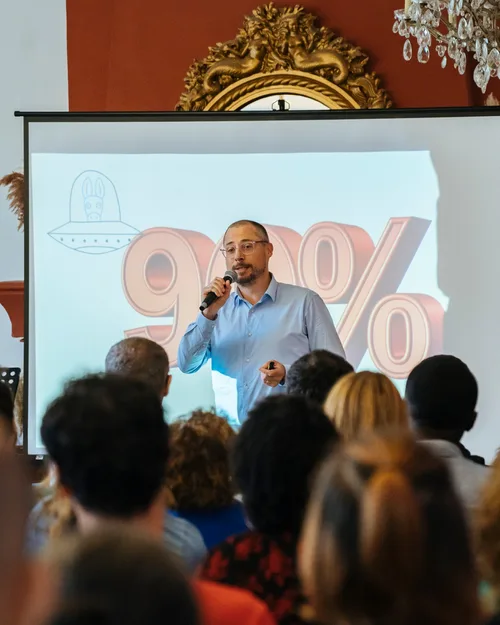
𝐖𝐡𝐲 𝐝𝐨𝐧'𝐭 𝐰𝐞 𝐮𝐧𝐝𝐞𝐫𝐬𝐭𝐚𝐧𝐝 𝐞𝐚𝐜𝐡 𝐨𝐭𝐡𝐞𝐫… 𝐚𝐭 𝐰𝐨𝐫𝐤 ? 𝘈𝘯𝘥 𝘩𝘰𝘸 𝘵𝘰 𝘵𝘳𝘢𝘯𝘴𝘧𝘰𝘳𝘮 𝘵𝘩𝘦 𝘓𝐈𝘌𝑵 𝘪𝘯𝘵𝘰 𝘢 𝘭𝘦𝘷𝘦𝘳 𝘰𝘧 𝘱𝘦𝘳𝘧𝘰𝘳𝘮𝘢𝘯𝘤𝘦. Damien Launay has been supporting organizations for nearly 20 years that want their teams to cooperate better. To the recurring question: Why, when everyone seems to have good intentions, does it still not work better? His answer is summed up in one word: the LINK. “𝗧𝗵𝗲 𝗲𝗾𝘂𝗶𝗽𝘀 𝗱𝗼 𝗻𝗼𝘁 𝗹𝗮𝗰𝗸 𝗰𝗼𝗺𝗽𝗲𝘁𝗲𝗻𝗰𝗲𝘀… 𝘁𝗵𝗲𝘆 𝗹𝗮𝗰𝗸 𝗹𝗶𝗻𝗸.” Known for his direct, lively, and jargon-free style, he offers conferences that alternate between awareness, interactions, and concrete tools, with a clear objective: to create lasting and actionable insights right from the start. 💬 What participants remember An intervention that “shatters certainties” and brings simplicity back to complex subjects. In the age of AI and generational effects, the importance of strengthening the link is glaring. A positive and engaging energy that immediately captures attention. Strong images (donkey, astronaut, 5 Cs) that remain in memory and continue to be used in teams. Concrete awareness about relationships, communication, and collective work. A conference that is unforgettable… and continues to live on thanks to the tools shared.

Prices

  • Conference : 3200 €

Localization

VANNES

Languages

French

My conferences

Conference #1

WHY DON'T WE UNDERSTAND EACH OTHER AT WORK?

WHY DON'T WE UNDERSTAND EACH OTHER AT WORK? And "Why don't we do what we know we should do?" It is with these questions that you will embark on a conference that challenges certainties... and transforms your way of working together. For 1 hour, you will discover how to overcome differences in perception to perform better as a team. On the agenda: ▶️ Understand why we do not have the same reading of a situation (limited rationality, generational differences, cognitive biases) 🧠 ▶️ Adjust our posture to gain relational impact and managerial effectiveness 💬 ▶️ Discover simple and concrete tools to better cooperate and engage teams 🔧 ▶️ Move from individuals who endure... to teams that move forward together 🚀 At the end: laughter, insights, concrete tools, and a new way of working in a team. 💬 They talk about it "On the D-day, Damien captivated the audience with his solar energy that allows us to think outside the box, his positivity, and his talent for making demanding subjects accessible. An impactful, fluid, and inspiring intervention." Virginie - TotalEnergies "A lively conference rich in concrete tools. Walking in the footsteps of the donkey allows us to find meaning and feel useful." Mickaël - Creator of theatrical experiences in companies "The young people still talk about it... about the astronaut as well as the donkey... about the 5 Cs... to stay on course in human and work relationships." Sandrine - Director of the local mission

Learn more

Who am I?

What I did before becoming a speaker

My relationship with the world of work began quite early, in central Brittany, first as a field worker, harvesting potatoes at 14 and raspberries at 16, then it continued with temporary work, notably in agri-food and aeronautics factories, and then I became a manager in the associative sector and in the parapublic. I am currently responsible for the transformation workshop at the Morbihan Department, an organization of 2,800 people. The activity of being a speaker is for me a bonus to share my experience and meet other visions of the world.

What made me become a speaker

The circumstance is a confined anniversary: on April 15, 2020, the evening of my 39th birthday, I decided to put down in a book what I had in my head and gut in one night. The result: I finished a year and a half later, accompanied by a talented illustrator: Clémence Barbier. And then it all picked up a bit with requests for conferences and meetings. It wasn't planned, but it's a huge thrill!

A failure or turning point that shaped me

I started as a summer field worker from 14 to 16 years old. Boxes of potatoes, trays of raspberries, we were paid by performance in a great atmosphere. Then I was a temp in agri-food and aeronautics, a sports journalist, a manager in the associative and parapublic sectors, a trainer, a project manager, and an organizational advisor. It is with this diverse experience that I speak, because it is in all these places that I understood the strength of CONNECTION in organizations.

What excites me about working as a speaker

The desire is to make concepts and good ideas accessible to work better together in companies. I have been immersed in managerial support for several years, so to speak, I have taken a good tour of the literature, documentation, and practice that exists on the subject. But it must be admitted that it is not always accessible, often redundant, and sometimes cloudy. Theorizing what needs to be done is good and necessary, but putting things into practice is a bit different. We need to bring the 'saying' closer to the 'doing' without hierarchy between the two. For me, the more people know, the more people will act to improve work.

The mission I'm carrying today

We must resonate to progress in business! The H factor is the one everyone must bet on if they want to succeed in the rest.

The belief or message I want to leave for the long term

I deeply believe that we must integrate that we are all donkeys, meaning that we all have a different truth and this is very well explained! And it is by recreating the link that we can become soul brothers, carry convictions rather than certainties, and thus positively evolve organizations. It is this strength of relationship that people sometimes mention to me several years after an event.

A personal story I often tell

With two friends, Christophe and Laurent, we created Dacrislau, a service company long before CESU existed and when we were only 16 years old. With this idea, we painted in a classified castle, served at numerous weddings, babysat children, walked dogs... All thanks to the trust that people had in us.

Where I'm from and what shaped my childhood

I am a Breton from the lands. There is Breton sap in me permanently, I spent my childhood there and have lived in Vannes for over 10 years. It is there that I drew a large part of my values. The pleasure of meeting, exchanging, and sharing in particular. What drives me is the desire to progress and enjoy life. I love people, starting with my family and friends. I make the most of the time spent with them.

The childhood dream that still follows me

Quite young, I imagined being an ethnologist, meeting unknown populations and discovering their world. On one hand, I have kept this curiosity for others and collective cultures.

My memory of speaking in public for the first time

Pleasure. It was with a group of about ten business leaders from a CJD to test my conference before presenting it to a large real estate group. They were attentive and gave me many tips to ensure the promise was met.

The people who most shaped who I am

I believe I am who I am thanks to what my parents gave me: LOVE and TRUST. I grew up in an area where everyone knew each other, with a very close group of friends. We were trusted, we were free, and we wanted to please people. It may seem a bit idealized, but it's really what I experienced.

The choice that most changed my trajectory

My path is not linear; it is built rather according to opportunities and sensations. For example, I was offered the direction of a large associative structure in Brittany right after finishing my studies, and I refused. I wanted to explore the world before returning to Brittany. And I believe that in the end, my path has a lot of coherence.

The values that guide my life off stage

Respect and freedom

What a normal day looks like for me

Conferences are a hobby that I pursue professionally. Some are very involved in associations and local life. On my side, today I meet with companies, with executives and teams, in groups of young and old leaders, in communities and associations. I want to participate in the movement by bringing energy and experience. I also want to take what others want to give. And this is very much linked to my current job because most of the time I manage a team of about ten people to bring the transformation of the Morbihan Department to life on 4 axes: robustness, digital, management, and environment.

How I recharge between engagements

Family and friends, essential resources for me.

The passions and interests that are part of my life

What drives me today is the desire to progress and enjoy life. I love people, starting with my family and friends. I make the most of the time spent with them. It’s my main hobby! Otherwise, I am naturally curious, so I read a lot. News, comics, thrillers, I don't rule anything out a priori. The same goes for music, which I mainly listen to when I go running. In any case, I always try to fully enjoy the present moment. And if I don't like it, I make sure it doesn't linger. I carry an optimism of will. Circumstantial pragmatism should not prevent dreaming. I embrace being a dreamer!

What I'm reading, watching, or learning right now

I am curious, so I rarely have just one book on the go. Right now, I am navigating between Malaven, a thriller set on a Breton island, a comic book dedicated to Kafka that I just finished, and The Illustrated Guide to Emotional Intelligence. I enjoy moving from one universe to another: fiction feeds the imagination, while personal development or humanities books nourish my reflection and my work.

The advice that most impacted my life

"Be yourself." It is a piece of advice of disarming simplicity, but probably one of the most difficult to apply sustainably. As the years go by, I realize more and more that authenticity is a tremendous accelerator: it simplifies relationships, strengthens trust, and allows us to build a path that truly resembles us.

What I'd tell myself ten years ago

I would tell her: "You are right to keep smiling. Life is beautiful, and it will continue to surprise you in a good way." I believe that optimism is an underestimated strength. It does not make difficulties disappear, but it helps to navigate the cycles of life with more serenity and confidence.

A fear or limit I'm still working on

Letting go when it comes to my children. I am someone who greatly values freedom, autonomy, and trust. Yet, as soon as their safety is concerned, I still discover areas for improvement. It is probably the greatest paradox of parenthood: learning to protect while allowing them to grow.

What I'm most proud of, beyond my résumé

I am proud of the journey I have taken and the person I have become. More than professional achievements, it is the overall balance that satisfies me: the values I try to embody, the relationships I have built, and the people around me. Today, I can sincerely say that who I am and what makes up my life deeply reflects me.

The next chapter that intrigues me

I strongly believe in life cycles. Some end, others begin, and each brings its share of learning and opportunities. I feel that a new chapter is about to open in my life. For now, it is still in preparation... so I will keep a part of the mystery. But it is precisely this phase of exploration that excites me the most.

Positioning & expertise

What concrete problem I can help your audience solve

I help organizations work better together. Behind tensions, misunderstandings, difficulties in cooperation, or transformations to be made, there is often a relational issue. My work consists of making these human mechanisms visible to allow individuals and collectives to move forward with greater fluidity, trust, and efficiency.

Why book me rather than another speaker?

Because I am one of those who believe that an idea is only valuable if it is understood, retained, and used by the greatest number. I enjoy transforming sometimes complex concepts into simple images, concrete stories, and accessible awareness for all. All with a lot of energy, a bit of humor, and a deep conviction: we are capable of doing better together.

My specialty in one sentence

I help organizations rekindle the flame of engagement through relational intelligence.

Topics I don't cover

I deeply believe in the richness of debate and the respectful confrontation of ideas. I rarely refuse a topic on principle. However, I am very careful to only speak about what I truly master. The world is vast, the expertise is numerous, and I prefer to stay in my rightful place rather than give the illusion of knowing everything.

My unique angle

I talk about serious subjects without taking myself seriously. My approach is to make sometimes very theoretical concepts accessible by using metaphors, stories, and everyday examples. I believe more in the power of an image that sticks in your mind than in that of a scholarly definition forgotten by the next day.

The field experience behind my message

I do not speak from an ivory tower. I have experienced potato fields, temporary work in industry, sports journalism, associative management, the parapublic sector, training, organizational support, and consulting. I have been managed, a manager, a collaborator, a project leader, and a passionate observer of human dynamics. It is this diversity that nourishes my conferences.

My speaking style in one or two sentences

Dynamic, accessible, and deeply human.

I love to create a moment where one learns without feeling like they are attending a class. Smiles, emotions, and reflection move forward together. A conference should inspire a desire to think differently, but also to take action.

Which audiences get the most from my sessions

Everyone who works with human beings, so it's broad... I have had the chance to speak to both leaders of large European banks and young people supported by local missions. Contexts change, stakes evolve, but relational mechanisms remain universal. Everyone leaves with keys adapted to their own reality.

Which types of organizations I'm the best fit for

For all organizations that consider the quality of human relationships to be a major lever for engagement, cooperation, and sustainable performance.

This applies to both private companies and local authorities, associations, or public institutions.

Concrete outcomes your audience can expect after I speak

A better understanding of oneself and others. When we better understand what drives us and what drives those around us, it becomes easier to cooperate, communicate, trust, and build a collective project. Participants leave with greater perspective, but above all with the desire to act within their inner circle.

The method, framework, or philosophy I stand for

Honestly, I believe that everyone is saying the same thing. We change the patterns and visuals, but in reality, we hear almost the same messages everywhere. I advocate for resonant management, but what matters most to me is the way to convey my message, fun and accessible to reach as many people as possible.

Results & credibility

Career highlights I want to emphasize

The diversity of the environments in which I have been able to intervene. Being able to move from a large international group to a local association or from a management committee to a young audience is an immense wealth. This diversity nourishes my reflection and reminds me every day that human issues far exceed statuses and functions.

Clients and sectors that have trusted me

I work with private companies, public institutions, banking and financial actors, local authorities, associations, training organizations, and many structures engaged in transformation or human development processes.

What organizers and audiences tell me most often

Two words consistently come up: energy and simplicity. Participants appreciate the ability to make complex concepts accessible and to create lasting awareness through images that they often continue to use months after the conference.

Where I shine most — and when I point you to another option

Conferences in front of a large audience are clearly my favorite playground.

I love the collective energy, the dynamics of a full room, and the possibility of engaging several hundred people in the same reflection. Conversely, when it comes to very technical training or in-depth support in a small group, I willingly recommend other speakers or other more suitable formats.

What I spotlight beyond my profile (book, certifications, proof, etc.)

My ability to create bridges. Bridges between generations, between professions, between functions, between those who decide and those who execute. I believe that dialogue remains one of the most powerful engines of collective transformation. And to learn more, there is my book "How to Move Your Donkey Forward?"

Speaking style

My energy on stage

Engaged, positive, and communicative. I believe that we remember more of what we feel than what we hear. My energy is never a show. It serves the message and the experience lived by the audience.

How audiences experience my sessions (participation, humor, pace)

Like a journey. A journey made of stories, smiles, reflections, and sometimes emotions. Everyone finds different resonances in it, but all are invited to look at human relationships from a new angle.

Visuals and personal stories: what to expect from me

Yes, enormously. I rely on a faithful companion who accompanies the audience throughout the journey. Metaphors, personal anecdotes, and strong imagery play a central role in my conferences. They make the messages more accessible, more concrete, and above all, more memorable.

Inspirational keynote vs hands-on workshop; improvisation vs tight structure — how I work

Definitely keynote. My conferences are very prepared and structured. The energy may give an impression of spontaneity, but the content is carefully constructed in advance. Each presentation is designed to address the client's challenges and the audience's expectations.

How I customize content and how much I tailor to you

Always. I even consider it the foundation of a good conference. Each assignment begins with a thorough exploratory exchange. Understanding the challenges, expectations, context, and intent then allows for the construction of a presentation that truly resonates with the audience present in the room.

What makes my sessions memorable

Because they combine energy, emotion, and simplicity. Participants generally leave with a few strong images, easy-to-remember models, and examples that they continue to use in their daily lives. When a metaphor resurfaces several months after the conference, it is often a sign that it has made its way.

The strongest moments and insights I create for audiences

Probably this one: we are all someone’s donkey. This idea brings a smile before inviting reflection. We all look at the world through different experiences, stories, and filters. Accepting this often allows us to replace judgment with curiosity and create the conditions for a more authentic dialogue, where we hold convictions rather than certainties.

The emotion or mindset I want people to leave with

Joy, optimism, and a sincere desire to act. If participants leave the room with a smile and the desire to take a first step towards improvement, then the mission is accomplished.

Concrete content

The main takeaways participants leave with

First, that human relationships are rarely complicated... but they are often complex.

Then that we have much more power than we think over the quality of our interactions. And finally, that understanding others often begins with better understanding ourselves.

Ultimately, participants leave with a simple conviction: it is possible to do better together.

What your audience can apply the very next day

This is an important criterion for me. If an idea is brilliant but unusable, it will remain at the bottom of a notebook. Therefore, I like to share tools and reflexes that can be tested the very next day: a different way of listening, questioning, giving feedback, approaching disagreement, and methods for building vision and action collectively.

Tools, methods, and exercises I provide

The one that stands out the most is the model of the '4 cons' which places Humans at the heart of management, relying on four simple and powerful pillars: trust, contact, constancy, and conciliation. Trust is the foundation of any high-performing collective: it combines self-confidence and trust in others. It is not decreed; it is built over time through daily and sincere interactions. It is contagious: each micro-connection (a greeting, a real listening) feeds a virtuous circle. Contact is the condition for making this trust live. Managing is not about piloting from a distance, but being present with those who do. Stepping away from dashboards to see the reality allows for better decision-making. The higher you are, the more essential ground contact becomes to avoid blind spots. Constancy brings the stability that teams need in a changing world. It relies on clear markers: values, rules of the game, collective identity. The manager must embody this coherence daily, in both words and actions. It is this regularity that secures, engages, and gives meaning in change. Conciliation is the art of deciding in complexity. It involves arbitrating between constraints and ambitions, without falling into soft compromise. It requires listening, discernment, and the ability to make choices. Bonus: the effective leader cultivates humility and accepts that they can be wrong, being CON in summary. It is by questioning themselves and learning from others that they progress and help their collective progress.

Myths and common mistakes I debunk

I dismantle several. The idea that others are unwilling. The idea that there is a universal way to manage. Or the idea that communicating consists solely of listening. I often remind that we are all someone’s donkey. This allows for a bit of humility in our certainties.

Real-world examples that best illustrate my message

Those from real life. I draw from my background, from the organizations I support, from sports, from family, from everyday situations. I love when participants say: 'Hey, that reminds me exactly of something I experienced.' It is often at that moment that the message finds its way.

Sensitive topics I address frankly, if any

Conflicts, tensions, misunderstandings, lack of recognition, the gaps between what we believe we are and the image others have of us, and then salaries. These are not always comfortable topics, but they are part of organizational life. I prefer to look at them honestly rather than pretend they do not exist.

Beliefs or ideas in the audience I aim to shift

I would like us to be a little less quick to judge and a little more curious to understand. I would also like to evolve this idea that performance and humanity are opposed. My experience shows me that organizations that move forward sustainably are often those that take the time to care about people.

The “aha moment” I aim for your audience

The first often comes when participants realize that the behaviors that annoy them in others usually have an explanation. The second comes when they understand that identity — what I believe I am — is not always equal to reputation — what others perceive. And then we all sing together, but that's a bit of a surprise!

Format

On-site, remote, or hybrid: what I accept and prefer

In-person exclusively, it's the energy that matters to me!

Limits & transparency

How I handle a difficult or low-energy audience

First of all, I start from the assumption that there is no bad audience. There are sometimes tired, cautious, distrustful audiences or those who did not choose to be there. That's different. My role then is to create a connection, find the right rhythm, and adapt my energy. With a bit of listening and a lot of sincerity, things usually end up unlocking.

If tech fails: how I respond

Very calmly.

I love my materials, but they are not the heart of the conference. The heart is the relationship with the audience.

If the technology decides to take a break, I simply continue in another way. The best stories worked very well even before the invention of the projector.

How I handle tough questions and running over time

Difficult questions are often the most interesting.

If I know the answer, I share it. If I don't know it, I simply say so. I have no problem with not knowing.

Regarding timing, I am very attentive to the framework defined with the organizer. A successful conference is also one that respects those who host it.

What can derail a session, in my view — and how I prevent it

The lack of preparation.

When you don't know the audience, the context, or the expectations, you significantly increase the risk of missing the mark.

This is why I place great importance on preparatory exchanges. A good conference starts several weeks before stepping on stage.

Logistics & organization

What technical setup I need on site

I am rather minimalist. A projection system (video and sound), a microphone suitable for the room, and a presentation monitor are usually sufficient.

My tech rider or logistics document

The brief I just made above is sufficient. It's not complicated to have me intervene.

How early I usually arrive before the event

I like to arrive early enough to get my bearings, meet the teams, discover the room, and feel the atmosphere.

Depending on the context, this generally means arriving an hour before the intervention.

Whether I travel internationally and if I need an interpreter

With pleasure, I have already been to Belgium and Luxembourg. However, I only intervene in French-speaking countries, my English would not be up to par...

My slides, filming, and reusing recordings

Yes, when it is relevant and planned with the organizer. However, I like to remind that a conference is never just about a support. The slides accompany the journey, but they do not replace the experience lived in the room. So filming is often a good complement.

My availability before/after, networking, meet & greet

Of course. I place great importance on exchanges before the event to understand the issues and personalize the intervention. And after the conference, I always appreciate discussions with participants. They often extend the journey in a very enriching way.

Working together

Why organizers like working with me

If we weren't on this exercise, I would let them answer this question. But what they often tell me is that they appreciate the simplicity of the exchanges, the preparation in advance, the ability to adapt, and the fact that they can count on me. Ultimately, I simply try to be as reliable behind the scenes as I am on stage.

Themes of my conferences

Take action

This speaker is interesting and i wish to know more
I'm looking for a speaker and need help