
Emilie Berthet
Speaker, author of Stop, I Take My True Place at Work! and founder of the media Elles Agissent
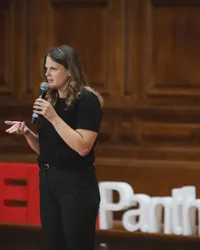
Émilie Berthet is a speaker, trained sociologist, author of "Stop, I Take My True Place at Work!" and founder of the media Elles Agissent. Selected among the 40 Women Forbes France 2025, she analyzes the invisible mechanisms that lead competent individuals to doubt their legitimacy, to give even more, to absorb the pressure from others, or to fade away to preserve their place. Her expertise has been built at the crossroads of several experiences: employee then team leader, entrepreneur, sophrologist, and interviewer of personalities from business, research, sports, and creation. This journey allows her to observe work both from the inside, through behaviors and emotions, and with the perspective of human sciences. In her book, published by Leduc Editions on October 8, 2026, she develops several original concepts to understand what is really at stake in organizations: the invisible debt, which leads one to believe that they must constantly prove their worth; the right to posture, which allows one to occupy a place without waiting to master all the codes; the mechanisms of emotional circulation, which show how pressure is transmitted in a hierarchical chain; or even professional authorization. Émilie Berthet helps leaders, managers, HR professionals, and teams identify what silently undermines engagement: lack of recognition, confusion between loyalty and constant availability, fear of showing limits, feelings of imposture, or even the emotional responsibility that some collaborators end up bearing in place of their hierarchy. Her conferences, embodied and accessible, blend personal stories, testimonies, sociological research, and directly transposable tools. They address very current issues: preventing over-investment and burnout, strengthening recognition, developing more conscious managerial practices, allowing the expression of vulnerability without undermining the collective, and creating the conditions for sustainable engagement. Émilie speaks at seminars, conventions, management-focused days, internal events, round tables, and meetings with executive teams. Her interventions are designed to provoke strong awareness, articulate words for often trivialized situations, and provide participants with concrete benchmarks to better inhabit their place, cooperate better, and work without having to distort themselves.
Prices
- Conference : 3500 €
- Animation : 4500 €
Localization
Languages
My conferences
Finding Your Place to Better Team Up: How to Reveal Your Uniqueness, Contribute Fully, and Move Forward Together
In organizations, everyone occupies a role. But occupying a role does not necessarily mean having found one’s place. Some people possess all the expected skills yet continue to doubt themselves. Others give more and more until they no longer know what truly falls within their role. Some adapt so much to their environment that they end up losing sight of their own needs, strengths, or unique way of contributing. Conversely, others struggle to perceive the space their colleagues need to express themselves and act. These discrepancies have very concrete consequences: misunderstandings, loss of meaning, rivalries, withdrawal, overinvestment, difficulties in cooperating, or a feeling of not being recognized at their true value. A trained sociologist, author of Stop, I Take My True Place at Work! and founder of the media Elles Agissent, Émilie Berthet explores the social, relational, and emotional mechanisms that shape our way of occupying a professional place. Her approach is based on a conviction: a team does not become stronger when all its members are alike or function in the same way. It becomes stronger when each person understands what they can bring, what they need to work well, and how their own way of acting aligns with that of others. Based on personal stories, research in the humanities, interviews, and immediately recognizable professional situations, the conference proposes a path in three movements: situating oneself, adjusting, and contributing. Situating Oneself We often confuse our position, our status, and our place. However, our place is also built in relationships, recognition, and what we think we must prove to remain legitimate. Émilie invites everyone to identify their real contribution, the skills they downplay, and the implicit roles they have gradually taken on. She introduces the notion of "invisible debt": this feeling of always having to do more to deserve one’s place. Adjusting Taking one’s place does not mean imposing oneself or fading away. It implies being able to express an idea, a need, a limit, or a disagreement while respecting the place of others. With the "emotional barometer", participants learn to distinguish what they feel, what they think they must show, and what they absorb in their professional relationships. Differences and tensions then become useful information for better cooperation. Contributing Finding one’s place makes sense when it allows one’s uniqueness to serve the collective. Everyone is invited to better understand what they bring, what gives them the feeling of being useful, and how their strengths complement those of others. Because place is not a scarce space to compete for: the more singularities are recognized, the more the team enriches its capacity to think and act. Embodied and interactive, the conference blends storytelling, humanities, professional situations, and concrete exercises. Participants leave with markers to better understand their place, identify the mechanisms of over-adaptation, and clearly articulate their contribution to the collective. Finding one’s place does not mean taking someone else’s, but understanding from which position we can bring the best of ourselves to the team.
They Act: from narrative to action. What women's trajectories reveal and transform in the company.
Companies are multiplying commitments in favor of equality, diversity, and women's access to responsibilities. However, representations sometimes evolve less quickly than the policies displayed. The proposed models often remain distant, exceptional, or difficult to transpose. Successes are celebrated, but the hesitations, detours, encounters, obstacles, and concrete decisions that allowed them to be built are less frequently recounted. Since the creation of the media Elles Agissent, Émilie Berthet has collected nearly 200 stories from women in business, research, sports, culture, entrepreneurship, and associative engagement. These very different trajectories reveal a common reality: action does not always begin with confidence, a perfectly defined plan, or the certainty of success. It often arises from an encounter, indignation, intuition, a need for usefulness, or the decision to no longer accept a situation previously considered normal. Émilie does not present these women as heroines to be admired from afar. She uses their stories as tools for understanding and transformation for the company. The conference revolves around three concrete contributions. Seeing what remains invisible The stories make visible the informal rules that shape paths: the codes that some master without ever having been explained, the skills that remain little recognized, the silent renunciations, but also the encounters and support that allow progress. They show that professional trajectories never rely solely on individual talent. They also depend on the spaces opened, the responsibilities entrusted, the words heard, and the people who choose to recommend, transmit, or trust. By sharing these stories, the company enriches its understanding of what truly facilitates or hinders the evolution of its talents. Broadening representations of success There is not just one way to lead, undertake, engage, or succeed. Some women advance out of ambition. Others out of conviction, necessity, or a desire to repair an injustice. Some build their place within existing institutions. Others invent their own framework. This plurality allows collaborators to identify with models that are closer, more accessible, and less rigid. It broadens the possibilities considered and questions certain implicit representations of leadership, authority, courage, or success. The stories do not tell participants what they must become. They allow them to imagine more ways to act. Transforming inspiration into action A story is only useful to the company if it produces a concrete shift. Based on the trajectories presented, Émilie invites participants to identify: a talent or contribution still insufficiently visible in their environment; a professional code that would benefit from being more widely transmitted; a person they could recommend, support, or connect; a practice that would allow more profiles to take on responsibilities; a action they postpone while waiting for perfect conditions. The conference thus allows a transition from admiration to transmission, and then from transmission to action. Embodied and accessible, the intervention mixes stories, excerpts from interviews, human sciences, collective reflection, and concrete exercises. It can address both women's networks and mixed teams, managers, or leaders. Participants leave with a different reading of professional trajectories, more diversified action models, and concrete levers to better recognize talents, circulate codes, and open the field of possibilities in their organization. Elles Agissent: from narrative to action is intended for seminars, conventions, leadership programs, internal networks, events dedicated to equality, and key moments around cultural transformation. Because stories do not transform the company only when they inspire. They transform it when they change what everyone thinks is possible — for themselves, for others, and for the collective.
Making Room for Artificial Intelligence Without Losing Ourselves: Redefining Its Value, Contribution, and Reference Points in a Transforming Work Environment
Artificial intelligence is rapidly establishing itself in organizations. It automates certain tasks, accelerates production, and transforms work habits. But behind the technical questions lies a deeper concern: what will our place be when the tool can accomplish in seconds part of what we used to do? This transformation can spark curiosity, but also doubt, resistance, or a feeling of devaluation. Some employees fear losing their skills or their usefulness. Others feel a new pressure: to produce even more since artificial intelligence is supposed to save them time. Gaps are also widening between those who already master the tools, those who hesitate to use them, and those who prefer to hide their practices. A trained sociologist, author of Stop, I Take My True Place at Work! and founder of the media Elles Agissent, Émilie Berthet analyzes what artificial intelligence transforms in our relationship to value, legitimacy, recognition, and the collective. Her approach is not to explain the technical functioning of the tools. She helps teams understand what their arrival shifts in roles, behaviors, and the feeling of professional usefulness. The conference revolves around three questions. What does artificial intelligence really transform in our work? An automated task does not necessarily represent a job eliminated. But it forces everyone to distinguish what they do from what they truly contribute. Émilie invites participants to identify the different dimensions of their contribution: field knowledge, judgment capacity, context understanding, creativity, relationship, cooperation, and responsibility. This clarification allows one to no longer base their entire professional value on the quantity of tasks completed. What do we do with the time and power gained? Artificial intelligence promises a time gain. But this time can quickly be absorbed by a new productivity requirement. The tool meant to lighten work can then reinforce the feeling of always having to do more, faster, and without downtime. The conference allows teams to collectively ask an essential question: do we want to use this time to produce more, or also to improve quality, deepen reflection, develop relationships, and cooperate better? What place do we choose to keep? Artificial intelligence can generate a response, a synthesis, or a recommendation. It does not bear the responsibility of the decision, nor the sensitive knowledge of a situation, nor the necessary relationship to act justly. Participants learn to distinguish three spaces: what can be delegated to artificial intelligence; what can be built with it; what humans must continue to decide, transmit, or embody. This mapping allows artificial intelligence to become a tool in the service of work, rather than a model that everyone should try to resemble. Embodied, accessible, and non-technical, the conference blends human sciences, professional situations, individual reflection, and collective exchanges. Participants leave with: a better understanding of what artificial intelligence transforms in their profession; a mapping of their contribution and professional value; guidelines to distinguish automation, cooperation, and responsibility; concrete questions to reuse in teams; a clearer vision of the place they wish to give to artificial intelligence. This conference is aimed at companies that wish to support the adoption of artificial intelligence without allowing fear, loss of meaning, hidden practices, or new performance pressure to settle in. For successfully integrating artificial intelligence is not just about deploying tools. It also involves enabling everyone to understand what changes, what they can delegate, and what they wish to continue to bring that is profoundly human.
Learn more
Who am I?
What I did before becoming a speaker
Before becoming a speaker, I worked for several years in recruitment and team management, notably as the head of a recruitment division. I then became an entrepreneur, sophrologist, and founder of the media Elles Agissent, through which I conducted nearly 200 interviews with women from business, research, sports, culture, and activism. This journey now informs my talks on workplace presence, legitimacy, emotions, and cooperation.
What made me become a speaker
What led me to become a speaker is primarily the pleasure of sharing: creating a connection with an audience, making a reflection lively, and circulating ideas in ways other than writing. But there is also a sense of urgency to convey certain messages. I want to articulate what many experience at work without always being able to identify it: doubt, over-investment, difficulty in finding one’s place, or acting without distorting oneself. The conference allows me to transform these observations into collective awareness and, above all, into concrete triggers.
A failure or turning point that shaped me
The failure that taught me the most was not knowing how to take my place during a difficult professional period. I didn’t always dare to say what I thought, set my boundaries, or express disagreement, because I still associated self-assertion with conflict.
In hindsight, I understood that it is possible to express things clearly without attacking, to position oneself without overpowering, and to protect one’s place without taking that of others. This experience taught me that silence does not always preserve relationships: it can also distance us from ourselves. I learned an essential lesson, both professional and personal: taking one’s place sometimes requires courage, but also accuracy.
What excites me about working as a speaker
What excites me about being a speaker is the encounter between an idea and an audience. I love making a reflection lively, creating a moment where everyone can recognize themselves, shift their perspective, and leave with a new understanding of what they are experiencing. The conference allows for transmission through the body, voice, stories, and emotion. It is this possibility of provoking both a collective awareness and a very personal trigger that fascinates me.
The mission I'm carrying today
My mission is to help everyone find their rightful place at work: a place where one can fully contribute, thrive, and express their uniqueness without fading away, distorting, or encroaching on others. I want to make visible the mechanisms that hinder this possibility, but also convey, through stories and the humanities, concrete guidelines for better individual and collective action.
The belief or message I want to leave for the long term
I wish to leave this conviction: finding one’s place does not mean taking someone else’s, but understanding from where we can fully contribute, without fading away or distorting ourselves. Long after the event, I would like everyone to remember that they do not need to wait to be perfectly ready or totally legitimate to act, and that a collective becomes stronger when singularities can truly express themselves.
A personal story I often tell
I often tell the story of the birth of Elles Agissent. At the time, I was still an employee and in the midst of a professional transition. One lunchtime, over a truffle pizza, I spoke to a colleague who had become a friend about my still fragile desire to create a media outlet to amplify the stories of women who are too often unheard. I asked her if she would agree to be the first guest, because she herself inspires me. She immediately replied yes, then added: "I can also introduce you to many other inspiring people." Where I still saw only an uncertain idea, she already saw a possible project. She believed in me before I fully believed in myself. A few weeks later, Elles Agissent was born. This story reminds me that a project sometimes starts with an intuition, but also with the gaze of someone who allows us to take it seriously.
The people who most shaped who I am
My mother, without hesitation. Her strength of character, her ability to bounce back in the face of challenges, and to maintain, despite everything, a true joy of living have profoundly shaped the person I am. She instilled in me the idea that one can go through difficult times without losing their momentum, curiosity, or ability to reinvent themselves. I believe I inherited from her this energy that drives me to transform obstacles into new paths.
How I recharge between engagements
Between two interventions, I need to release the accumulated intensity. Running helps me get my body moving, relieve the pressure, and regain mental space. Conversely, I also enjoy the very simple pleasure of sitting on a terrace with a coffee, observing my surroundings, and letting ideas come back. Movement frees me, calm recharges my creativity.
What I'm most proud of, beyond my résumé
Beyond the resume, I am especially proud of having dared. Several times, my mind, my fears, and my doubts told me not to go for it. I went anyway. I didn't always do it with confidence, but with the conviction that I had to move forward despite the fear. This is undoubtedly what I am most proud of: not waiting until I was no longer afraid to act.
Concrete content
What your audience can apply the very next day
J’apporte des clés concrètes pour aider chacun à mieux comprendre sa place au travail et sa manière de contribuer au collectif. Mes interventions s’appuient sur des concepts issus de mon livre, comme la dette invisible, le droit à la posture, le baromètre émotionnel et les mécanismes de circulation émotionnelle.
Je propose également des grilles de lecture, des exercices de positionnement, des questions à réutiliser en équipe et des outils pour distinguer engagement, suradaptation, légitimité et contribution réelle. L’objectif est que les participants repartent avec un langage commun, une meilleure compréhension de leurs comportements et des pistes immédiatement applicables dans leur quotidien professionnel.
Logistics & organization
Whether I travel internationally and if I need an interpreter
Déplacements internationaux : oui.
Interprète nécessaire : oui
My slides, filming, and reusing recordings
Oui.
My availability before/after, networking, meet & greet
Oui