
Stephane Ginocchio
Stéphane Ginocchio is a speaker on applied neuroscience in management, a specialist in cognitive biases, decision-making, and sustainable performance in business. He teaches at the Collège de Paris.
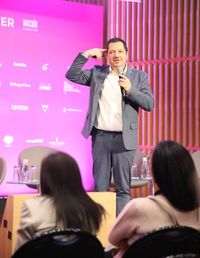
In most organizations, performance difficulties do not come from tools or strategy. They come from invisible mechanisms that influence decisions, behaviors, and daily relationships: cognitive biases. Decisions made too quickly, persistent tensions, misunderstandings, resistance to change, mental fatigue… These situations often have a common origin: unconscious mechanisms that guide choices without the teams being aware of it. It is precisely on these mechanisms that Stéphane Ginocchio intervenes. A specialist in applied neuroscience in management, a permanent professor at the Collège de Paris, he supports leaders, managers, and teams to concretely improve the quality of decisions and collective performance. A former leader for over twenty years in the IT-medical sector, he brings a dual perspective: scientific and operational. He is also the creator of the SCOPE® tools, designed to identify and regulate the dominant cognitive biases in a professional context. What his conferences concretely bring His conferences are not theoretical. They allow participants to immediately understand what really influences their decisions and behaviors. Through interactive demonstrations from neuroscience, participants discover: – why good managerial intentions sometimes produce opposite effects – how cognitive biases distort the perception of situations – how cognitive load degrades the quality of decisions – why certain tensions persist despite efforts – how to regain control in an uncertain and complex environment Participants experience the mechanisms live, allowing for rapid and lasting awareness. Observed results Organizations generally notice: – an improvement in the quality of decisions – a reduction in errors related to cognitive biases – smoother working relationships – a better level of engagement – a more stable collective performance For whom? This conference is aimed at organizations facing: – difficulties in decision-making – recurring tensions between teams – cognitive overload and mental fatigue – resistance to change – issues related to the integration of artificial intelligence Format Interactive conference with concrete demonstrations from applied neuroscience, immediately transposable to a professional context. Positioning Unlike traditional approaches focused on motivation or skills, Stéphane Ginocchio addresses the root cause of dysfunctions: cognitive mechanisms. His approach does not aim to eliminate biases but to enable individuals and teams to identify, regulate, and transform them into performance levers. His message is direct: Understanding what influences us allows us to regain control of our decisions and sustainably improve collective performance.
Prices
- Conference : 4500 €
Localization
Languages
My conferences
Invisible Cognitive Load and Performance
Invisible cognitive load and performance: understanding what truly exhausts teams. Decision-making, attention, mental overload: the invisible mechanisms that impact performance, engagement, and work quality. In many organizations, the decline in performance, decision fatigue, and disengagement cannot be solely explained by visible workload. An essential part remains invisible: cognitive load. Constant micro-decisions, interruptions, uncertainty management, time pressure, multiplicity of tools... These demands continuously activate the cognitive system and deplete attentional resources, without being identified as risk factors. This cognitive overload leads to direct effects: – increased cognitive biases – faster but less reliable decisions – loss of clarity and judgment – relational tensions and communication errors – lasting mental fatigue and gradual disengagement. Through an approach based on applied neuroscience, this conference makes the invisible visible. Stéphane Ginocchio proposes to understand how the brain functions under overload and why some organizations inadvertently degrade the quality of decisions and interactions. Participants will discover, in particular: – the mechanisms of cognitive load and decision fatigue – the link between mental overload and dominant cognitive biases – the impact of interruptions and multitasking on performance – the effects of pressure and uncertainty on the decision-making system – concrete levers to restore cognitive bandwidth. The conference relies on concrete demonstrations from neuro-pedagogy, allowing for immediate and measurable awareness. Objective: to restore teams' capacity for concentration, discernment, and sustainable performance by directly addressing cognitive mechanisms.
AI and Cognitive Biases: Regaining Control of Decisions in the Age of AI
When artificial intelligence amplifies our biases: understanding, anticipating, and securing human and organizational decisions. Artificial intelligence profoundly transforms managerial practices, decision-making processes, and modes of collaboration. However, it does not eliminate cognitive biases. On the contrary, it can amplify, automate, and render them invisible. Confirmation bias, dependence on recommendations, illusion of algorithmic objectivity, technological authority bias: these mechanisms now influence decisions at an unprecedented speed and scale. In this context, the question is no longer just technological. It becomes cognitive and strategic. Through an interactive conference based on applied neuroscience, Stéphane Ginocchio proposes to understand how the brain interacts with artificial intelligence systems, and why this interaction can produce biased decisions without individuals being aware of it. The conference notably allows participants to: – understand the role of cognitive biases in the use of AI – identify the risks of overconfidence and excessive delegation – analyze the influence mechanisms of algorithmic recommendations – develop a lucid managerial posture in the face of AI tools – secure decisions in hybrid human-machine environments Participants experience concrete demonstrations highlighting biases in situ, in order to transform theoretical awareness into operational competence. Objective: to enable leaders and teams to regain control of their decisions in an environment where artificial intelligence becomes a full-fledged actor.
The biases that govern you limit performance
Decision-making clarity: understanding what governs you to unleash collective performance or The invisible biases that sabotage your decisions (and how to transform them into performance) In most organizations, the real brakes are neither technical nor strategic. They are invisible. Intangible. Cognitive. Biased decisions, recurring tensions, persistent misunderstandings, resistance to change, loss of engagement: these phenomena often find their origin in unconscious mechanisms that we do not see… but that govern us. Through an interactive conference based on applied neuroscience, Stéphane Ginocchio makes visible the dominant cognitive biases that influence our individual and collective decisions. A permanent professor at the Collège de Paris, researcher, and creator of SCOPE® tools, he connects neuroscience, management, and metacognition to help leaders and teams to: – understand why intention does not guarantee impact – identify the biases that alter decision quality – transform cognitive interferences into performance levers – develop sustainable managerial clarity – secure engagement in a context of uncertainty and artificial intelligence. His interventions are not limited to transmitting knowledge. They bring the experience of biases to life through concrete demonstrations, allowing for immediate and measurable awareness. What was unclear becomes readable. What was conflictual becomes understandable. What hindered performance becomes a lever for alignment and collective effectiveness. Objective: to transform unconscious determinisms into adaptive power.
Learn more
Positioning & expertise
What concrete problem I can help your audience solve
Why do highly competent teams sometimes make decisions that are clearly counterproductive… while believing they are right? Why do certain professional tensions persist despite the intelligence, goodwill, and experience of individuals? What if part of the problem came less from the individuals themselves… than from the way their brains reconstruct reality?
I work on these invisible mechanisms: cognitive biases, mental overload, automatic interpretations, decision fatigue, perception errors, and collisions of representations of reality.
Why book me rather than another speaker?
Because I do not just talk about neuroscience: I make it perceptible.
My conferences are based on immersive neuro-experiences during which the audience directly experiences the mechanisms of their own brain: perception, memory, attention, interpretation, certainty, reconstruction of reality.
At a specific moment, something shifts: the participants realize that their brain does not always show them reality as it is… but an interpreted, simplified, and sometimes biased version.
And this awareness profoundly changes the way to approach management, communication, and decision-making.
My specialty in one sentence
I explore how intelligent brains can produce irrational decisions… with a perfectly sincere impression of rationality.
Topics I don't cover
Neuroscience should not be used to confine individuals into categories, but to develop greater lucidity and nuance.
My unique angle
I do not talk about the brain as a theoretical subject. I create situations where the audience sees their own brain reconstructing reality… live.
For a few seconds, participants experience something disturbing: they discover that their perception, certainties, memories, or interpretations can be automatically fabricated without their awareness.
This is the uniqueness of my approach: I transform neuroscience into lived experience.
My conferences do not just aim to transmit knowledge. They provoke what I often call a “shift of the cognitive firewall”: the moment when one stops thinking that biases mainly concern others… and starts observing their own mental mechanisms in action.
From there, communication, management, and human relations are no longer viewed quite the same way.
The field experience behind my message
Before teaching applied neuroscience, I worked in radiology and then founded and led a company in the medical IT sector for over twenty years. I observed how the most costly difficulties were not always technical, but human: cognitive overload, decision-making rigidity, relational tensions, perception biases, or emotional fatigue.
Today, I connect this field experience to cognitive neuroscience to make these mechanisms visible and operational.
My speaking style in one or two sentences
Scientific, immersive, and deeply experiential.
I do not just seek to transmit knowledge. I create situations where the audience observes their own brain producing an interpretation, a perceptual error, or an automatic certainty.
And when this experience is lived rather than explained, memorization becomes extremely powerful.
Which audiences get the most from my sessions
Leaders, managers, HR professionals, teachers, healthcare professionals, transformation teams, trainers, salespeople, and more broadly all organizations facing human complexity.
Whenever communication, cooperation, decision-making, or relational tension is involved, neuroscience becomes an extremely concrete lever.
Which types of organizations I'm the best fit for
Organizations facing transformations, high cognitive load, engagement, management, cooperation, or communication challenges.
Because many organizational difficulties are not solely related to strategy or processes, but also to how individuals perceive, interpret, and react to situations.
Concrete outcomes your audience can expect after I speak
Better decision-making lucidity. A finer understanding of human reactions. Clearer exchanges. A reduction of certain unnecessary tensions. And above all, a lasting awareness:
we do not react directly to reality, but to the representation that our brain constructs.
The method, framework, or philosophy I stand for
Yes!
I work a lot around what I call the “shift of the cognitive firewall.”
Initially, everyone naturally thinks: “I am rational.” “I see things objectively.” “Biases mainly concern others.”
Then a neuro-experience creates cognitive friction: a perceptual illusion, a memory error, an unexpected automatic interpretation.
At that moment, something changes. The participant discovers that their own brain also constantly reconstructs reality.
It is this shift that then opens up metacognition, nuance, and better relational quality.
Results & credibility
Clients and sectors that have trusted me
Consulting, large public and private enterprises in finance, insurance, personal assistance... Business School... and the Ministry of Economy.
What organizers and audiences tell me most often
“I will never look at certain situations the same way again.” “It’s disturbing because you experience it yourself.” “We finally understand why intelligent people can sincerely misunderstand each other.” “It was not just a conference, it was an experience.”
Where I shine most — and when I point you to another option
from my experience of 10 to 300 people.
What I spotlight beyond my profile (book, certifications, proof, etc.)
More than 30 publications with DOI, including 4 FNGE articles 1 book: 40 neuro-experiences to change management 2 books on neuroscience and management and neuroscience and AI in business Eyrolles to be published in 2027 and above all, an average satisfaction rating of 9.93/10 for over 3 years on my interventions, which benefit from an evaluation system.