

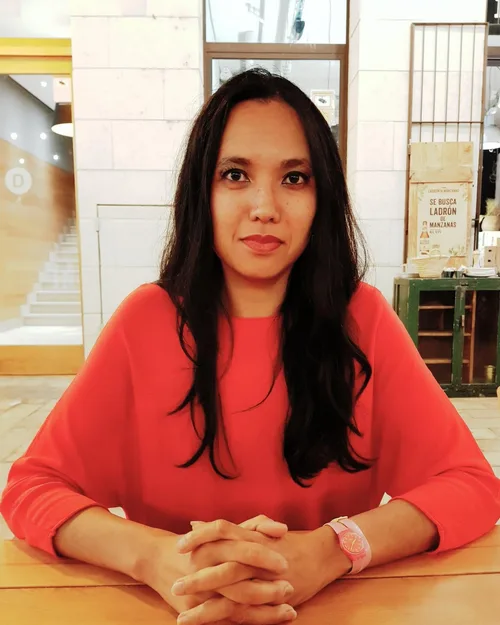
Thanh Agullo - Speaker on sante mentale
Child and Adolescent Psychiatrist · Survivor of the boat people · The only trilingual French-speaking child psychiatrist in the world
I was born in Saigon in 1975. At 3 years old, my family fled Vietnam — boat people, political refugees. We almost didn’t make it.
I grew up in France, studied medicine in Lyon, and became a child and adolescent psychiatrist. It took me 47 years to find my way back to my homeland — and I return today as an international speaker.
I am the only trilingual French-speaking child psychiatrist in French, English, and Vietnamese. This profile does not exist anywhere else.
For 20 years I have practiced psychiatry and psychotherapy. Since 2021 I have been an Expert Psychiatrist for Teale, a B2B mental health platform at work, working with Cartier, Sanofi, AWS, SNCF, Guerlain, and Air Liquide. I have designed and filmed series of mental health videos distributed to all of their corporate clients. I am the author of two popular books, a live contributor on France 3, interviewed on the radio, and a speaker at the RMIT Vietnam Wellbeing Summit in October 2026. My specificity: I am both a clinician and a communicator. Scientific rigor without jargon. Human warmth without complacency. And a story that, to this day, belongs only to me.
Need a speaker on these topics?
Frequently asked questions
Which topics does Thanh Agullo cover as a speaker?
Thanh Agullo speaks on the following topics: sante mentale, resilience and bien etre au travail.
How do I book Thanh Agullo for a conference?
To book Thanh Agullo, contact the Lespeakers agency. An advisor will call you back to scope the event, dates and format.
How much does a conference with Thanh Agullo cost?
Thanh Agullo's fees:
- Conference : 5500 €
Booking is handled through Lespeakers.
Which languages does Thanh Agullo speak on stage?
Thanh Agullo speaks as speaker in french, english and vietnamese.
Where is Thanh Agullo based?
Here is where Thanh Agullo is based: Europe/north America/apac.
What led Thanh Agullo to become a speaker?
Exile. Leaving at 3 as a boat person, growing up between two cultures, never quite belonging to one world — and choosing to make this fracture a strength. Psychiatry gave me a language for what I was experiencing without being able to name it.
Why book Thanh Agullo rather than another speaker?
I am a psychiatrist — not a coach, not a psychologist. I bring medical credibility, real clinical data, and 20 years of field experience. And I am trilingual in French, English, and Vietnamese, born in Saigon: an authentic bicultural profile that no one else has.
What is Thanh Agullo's speaking angle?
Psychiatrist + author + Franco-Vietnamese bicultural profile + 20 years in practice = I speak about mental health with the rigor of a doctor and the warmth of a human who has been through it all.
How does the audience experience a talk by Thanh Agullo?
He laughs, he recognizes himself, he is silent at the right moment. I mix clinical humor, true stories, and striking data. This is not a lesson — it is an experience.
Why do organizers like working with Thanh Agullo?
I am reliable, responsive, and I don't complicate things. I ask for a serious brief, I deliver what I promise, and I adapt if the context changes. I am not called back a second time because it is obligatory — but because it is desired.
They appreciate my dynamism, my boldness, my humor, a bit provocative;)
What concrete results can the audience expect after a talk by Thanh Agullo?
Knowing how to identify an emerging burnout, having a simple action protocol, understanding legal obligations, and leaving with at least one immediately applicable tool.

His conferences
Why Women Cry and Men Have a Drink: What Psychiatry Really Says About Gender Differences
Women represent 70% of depressive patients. Men die by suicide three times more often. These figures are not a matter of chance — they tell something profound about how our societies allow or forbid emotional expression according to gender. This conference is drawn from my doctoral thesis and my latest book — Why Women Cry and Men Have a Drink, published in June 2026 — and twenty years of psychiatric consultation. It explores, with humor and clinical rigor, the biological, psychological, and social mechanisms that explain these differences. What you will learn: why women are overrepresented in depression and what that says about our healthcare system. How men express their suffering differently — and why we don't see it. What companies can concretely do to adapt their mental health policies according to profiles. A conference that makes you laugh, makes you think, and provides tools — for HR managers, managers, and anyone who wants to understand what is really happening behind the facades.
My Teen Doesn't Listen to Me Anymore, My Child is Addicted to Screens: What Every Working Parent Should Know
Working parents are exhausted — not just by their jobs, but by the invisible mental load that raising a child or teenager represents today. Ubiquitous screens, rising school anxiety, deteriorating communication, teenagers shutting down. And at the office, these parents are physically present but mentally absent. As a child psychiatrist with 20 years of experience consulting with children, teenagers, and their families, I provide a clinical and practical response to these questions that HR managers hear but don’t know how to address. What you will learn: why excessive screen use is often a symptom, not a cause — and how to discuss it without conflict at home. How to maintain a trusting relationship with a teenager who is shutting down. What warning signs to watch for and when to seek help. How companies can support their parent-employees without interference. A talk that speaks to all the parents in the room — with the rigor of a doctor, the warmth of a mother of three, and concrete tools to apply starting tonight.
Rebuilding After Adversity: Lessons from a Survivor Psychiatrist - What Science Teaches Us About Resilience, Meaning, and Returning to Oneself
What allows us to rise after an ordeal — a loss, burnout, or identity collapse? This conference draws on 20 years of psychiatric practice and a unique personal story: that of a doctor born in Saigon, torn from her country at the age of 3, and returned 47 years later. From this experience of rupture and reconstruction emerged a clinical conviction: resilience is not decreed, it is built — through meaning, connection, and the courage to face what has happened. Through concrete clinical cases, recent neuroscientific data, and immediately applicable tools, this conference explores the mechanisms of psychological rebound. Why do some people rise while others collapse? What role do attachment, identity, and self-narration play in reconstruction? How can companies support their employees during difficult times? A conference that combines clinical rigor, authentic emotion, and pragmatism — for HR audiences, managers, and anyone who has gone through an ordeal.