
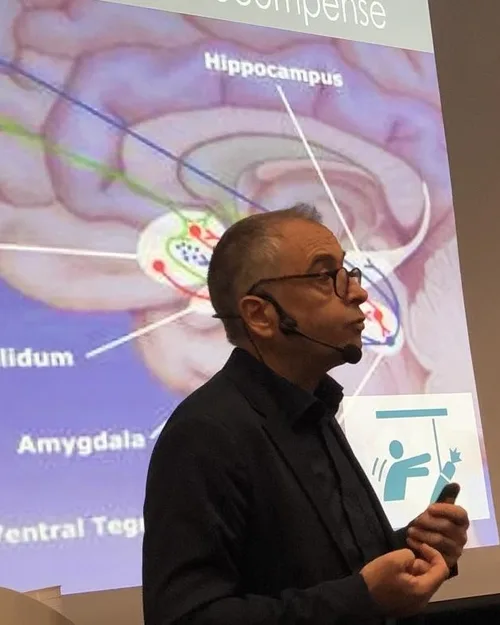
Bernard Anselem - Speaker on neurosciences
Doctor of Medicine and Master's Research in Neuropsychology. Getting the Best Out of Your Brain in Critical Situations
Doctor, Master's Research in Neuropsychology, speaker-author What interests me is helping people get the best out of their brains in critical situations such as complex decisions, exhausting rhythms, intense stress, the need to involve collaborators or convince clients, loss of motivation due to fatigue, and adapting to constant change. To achieve this, I use advances in cognitive science research (neuroscience and experimental psychology). Knowing a minimum of brain function is not a luxury; it is vital to avoid exhaustion and choose the best strategies. Leveraging underutilized potentials, knowing the limits, helps us make better decisions, develop collective intelligence, adapt to changes and various difficulties, understand others, and better activate sustainable motivational forces for ourselves and others. I rely on the advances in research and the revolution in cognitive sciences to make the best use of our skills. These disciplines enlighten us on the major brain functions useful for progress: decision-making, emotional and relational intelligence, cooperation, deep motivations, intuition, stress, creativity, concentration, and learning. They help us use our brain capacities more finely, without wasting time and energy.
Need a speaker on these topics?
Frequently asked questions
Which topics does Bernard Anselem cover as a speaker?
Bernard Anselem speaks on the following topics: neurosciences, intelligence emotionnelle, prise de decision, gestion du stress, motivation, changement, leadership and psychologie.
How do I book Bernard Anselem for a conference?
To book Bernard Anselem, contact the Lespeakers agency. An advisor will call you back to scope the event, dates and format.
How much does a conference with Bernard Anselem cost?
Bernard Anselem's fees:
- Conference : 3000 €
Booking is handled through Lespeakers.
Which languages does Bernard Anselem speak on stage?
Bernard Anselem speaks as speaker in french.
Where is Bernard Anselem based?
Here is where Bernard Anselem is based: Chambéry.
His conferences
Emotional Intelligence, Why Are We So Bad?
Multiple studies show that emotional intelligence improves physical and mental health, well-being, work efficiency, relational quality, resilience, and strategic choices: it enables us to select crucial information in a complex and stressful environment, and above all, it can be cultivated with validated methods. Understanding our emotional brain to progress: from emotion to action. Distinguishing what is modifiable from what is beyond our reach. What is accessible to our will and what is not. What are the most effective regulation methods. How to apply them.
Adapting to Change: Making the Most of Your Brain
How to leverage neuroplasticity and know how to preserve your brain: the explosion of knowledge, uncertainties, the acceleration of rhythms, and the succession of various crises impose exhausting efforts on our organism. In this context, knowing our brain is not a luxury; it is essential to avoid burnout and make the most of our adaptive capabilities. Identifying resistance factors and the potentials of our brain helps us manage this flood of innovation and stress. Understanding the potentials of neuroplasticity, factors of neuronal growth, and their impact on mental flexibility. Adopting the right mindset and managing our sources of resistance to change. Examples of biases and reasoning distortions. Initiating change among collaborators. Emotional intelligence. Emotions guide us unconsciously. What elements can we act upon? How to identify, tame, and best utilize them for our own interests and those of our teams. Using emotional networks of motivation and pleasure to adapt to changes and difficulties. How to activate the networks of desire and motivation in oneself and others, how to inspire change and collective intelligence for your teams. Managing your energy and mental load over time, making the most of your brain in stressful situations.
Deciding in Uncertainty: Insights from Neuroscience
Decision-making in situations of uncertainty and complexity: when we make a complex decision, we do our best to analyze, weigh the pros and cons, and decide as rationally as possible, convinced that it is a rational decision. But in real life, the number of uncertain, unknown, or risky parameters is infinite. The brain must cling to what it knows to produce its reasoning and intuitions, but reality often undermines plans and predictions. What are the underestimated pitfalls and potentials? What are the emotional influences, when to use our reasoning, when to listen to our intuitions? Both have their place, but not in the same circumstances. How to use them discerningly. Better understanding the brain's decision-making processes helps us respond with nuance to this delicate question and reconcile the emotional (subjective feelings) and scientific (reason) worlds. Emotions help us, provided we know under what conditions to be wary of our cognitive biases. Emotional influences on decision-making Advantages and limitations of intuitive decision-making When to favor analysis, when to prefer intuition.
Neurosciences Renew Motivation
Motivation is at the core of effectiveness; it cannot be decreed but must be cultivated. Why do some people climb mountains while others become discouraged or weary along the way? In the face of the efforts required, a lasting desire that does not wane is necessary. Understanding the neural laws of deep motivations allows us to comprehend the mechanisms of discouragement, boredom, and especially to identify motivations that withstand exhaustion or disinterest. How to progress in effectiveness, give the best of oneself, and unleash our energy by effectively stimulating our motivational networks. The brain functions of motivation How to activate them sustainably How to transmit them to others to engage